Biography & Career Overview
Ramdev (born Ram Kisan Yadav, known to hundreds of millions simply as Baba Ramdev or Swami Ramdev) is a renunciant monk who became one of India's most consequential businessmen, and a yoga teacher whose television classes built a mass following. His anti-corruption hunger strike in 2011, and the police eviction from Ramlila Maidan that ended it, shook the government. The birth name matters to this archive: the man who took the name of a deity when he swore vows of renunciation was born into a Yadav family of illiterate farmers in Alipur village of Haryana's Mahendragarh district, and the published biographical literature records his original name as Ram Kisan Yadav, meaning "Ram, the farmer's son". He has organised and taught mass yoga camps across India since 2002, broadcast on Indian television to audiences that his own company's marketing machine and his supporters number in the tens of millions. In 2006 he co-founded Patanjali Ayurved, which grew into one of India's highest-grossing FMCG firms, and in 2011-2012 he led protests against corruption and for the repatriation of black money that drew some of the largest crowds of the era. He is also among the most contested figures in Indian public life, with open controversies about his scientific claims, his advertising and his public statements, which this profile documents.
Early Life in Alipur: Ram Kisan Yadav
He was born Ram Kisan Yadav between 1965 and 1975 (the record preserves the range, not a settled date, and this profile reports it the same way) to Ram Niwas and Gulabo Devi, illiterate farmers of Alipur village in Mahendragarh district of Haryana, a dry, hard-scrabble region on the state's southwestern edge. He grew up herding cattle in his parents' fields, one of four children: an older brother, a younger brother and a younger sister. The left side of his face has been partly paralysed since childhood, possibly a congenital disability. He has said the condition found relief through yoga, a personal claim that is itself part of his origin story, since the discipline he later sold to the world he first sold to his own body. The family's Yadav identity is recorded in the biographical literature. His younger brother Ram Bharat later became a figure inside the Patanjali enterprise, described in reporting as the company's de facto CEO, and other relatives moved to Haridwar as the business grew.
Gurukul Education and the Renunciant's Name
Ramdev attended a government school at Shahbazpur until the eighth standard, then, after reading Dayananda Saraswati's Satyarth Prakash, the Arya Samaj manifesto, left what he considered the Macaulay-designed curriculum for a gurukul system at Khanpur at around age nine. From 1984 to 1989 he studied at Arsh Gurukul Mahavidyalaya. At fourteen he moved to Kalwa to study under Acharya Baldevji, one of his principal gurus. It was at Kalwa that he met Acharya Balkrishna, the fellow student who would become his lifelong business partner. There he learned Sanskrit language and literature, Hindu philosophical texts and the traditions of yoga and asceticism, while giving free yoga training to villagers. After completing his studies in 1992 he went to Haridwar, staying at the Kripalu Bagh Ashram under Shankardevi Maharaj and learning yoga from Acharya Karamveer. There he took vows of renunciation, entered sannyasa and adopted the name Ramdev, abandoning, in the classic manner of the Indian ascetic, his family name along with his worldly future. On 5 January 1995 Ramdev and Balkrishna, together with Acharya Karamveer, founded the Divya Yoga Mandir Trust at Kripalu Bagh, running yoga camps and an ayurvedic pharmacy; between camps Ramdev spent time as a meditator in Gangotri and, with Karamveer, sold chyavanprash in Haridwar.
Television Yoga: The Mass Guru (2002-2006)
Ramdev began appearing on television as a yoga instructor in 2002 on Sanskar TV, and from 2003 held the morning yoga slot on Aastha TV, where he proved exceptionally telegenic: bare-chested, saffron-clad, commanding crowds of followers in synchronized pranayama before a studio camera. His camps drew huge audiences in India and abroad (students in the United Kingdom, the United States and Japan) and in 2009 he addressed Muslim clerics at the Deoband seminary. At Yog Gram, his main yoga centre in Haridwar, he practices and teaches in an auditorium built for broadcast; his organisation estimates that his programme "Om Yog Sadhana" commands tens of millions of followers. In 2006 he was invited by Kofi Annan to speak on poverty alleviation at a United Nations conference, and in October 2014 he was one of nine personalities invited by Prime Minister Modi to launch the Swachh Bharat Mission.
Patanjali: The Renunciant Who Sells Nothing He Owns
In 2006 Ramdev and Balkrishna founded Patanjali Ayurved, a fast-moving consumer goods company based in Haridwar that grew into one of India's highest-grossing FMCG firms, a swadeshi-movement business model in toothpaste and chyavanprash form: Ramdev has urged Indians to reject multinational brands and built a product empire on the appeal. The ownership structure is the famous paradox of his biography. As a renunciant, Ramdev holds no shares. Balkrishna, the company's CEO, owns 96%, while Ramdev is its public face and, by his own account, makes most business decisions. In 2013 he declared his personal assets at around ₹1,100 crore. The Patanjali ecosystem extends well beyond the goods company: Patanjali Yogpeeth, the yoga-and-ayurveda institute with two Haridwar campuses and centres abroad (Ramdev is its vice-chancellor; he also opened a UK charity and acquired the Scottish island of Little Cumbrae to extend it), the Divya Pharmacy, whose medicines began at his guru's ashram in 1995, and Patanjali Wellness, the wellness-centre chain whose planned IPO was announced in 2022. In January 2026 the Patanjali Emergency & Critical Care Hospital opened in Haridwar, inaugurated with the Union Home Minister. Ramdev announced a large yoga and wellness centre in Goa the same month, and in June 2025 a mega food park project in Andhra Pradesh's Vizianagaram district.
Ramlila Maidan: The Hunger Strike That Made Him a National Force
In April 2011 Ramdev called for punitive powers in the Jan Lokpal Bill and announced an anshan at Ramlila Maidan, Delhi from 4 June 2011, a hunger strike against corruption and black money. Talks with the government collapsed on the eve of the fast; shortly before midnight on the first day police (citing a permit for a 5,000-person yoga camp, not a 50,000-person protest) dispersed the crowd with tear gas and lathi charge. Ramdev, briefly disguised in women's clothes to evade arrest, was flown to Haridwar and banned from entering Delhi for fifteen days. He declared the fast unbroken, was hospitalised on the eighth day, and ended it on the ninth, to nationwide commentary. The crackdown drew condemnations from across the political spectrum: L.K. Advani called it "naked fascism" and Anna Hazare a "strangulation of democracy". One woman protester died after the police action, and Ramdev memorialised her as a sacrifice to the cause. He launched a second indefinite fast at Ambedkar Stadium in August 2012, ending it on 14 August declaring "we are leaving because we won." Politically, his Bharat Swabhiman platform announced it would contest seats in the 2014 general election, and he voiced support for Narendra Modi's premiership that year, an alignment with the BJP that has continued, with friction, since.
Controversies: Medicine, Statements and the Courts
A biography of Ramdev that omits the contested record is not a biography. Coronil, announced in June 2020 as a COVID-19 "cure," was permitted by the government only as an immunity booster, banned in Maharashtra, fined ₹10 lakh by the Madras High Court for "exploiting fear and panic," and withdrawn as a cure claim amid criminal complaints in Bihar and lawsuits elsewhere. In May 2021 he questioned the need for oxygen for COVID patients and called modern medicine a "stupid science," remarks he withdrew and apologised for, before an open letter to the Indian Medical Association that doctors called a non-apology; the Delhi High Court declined to enjoin his speech in June 2021 but in August 2022 told him not to mislead the public against modern medicine, and the Supreme Court issued a contempt notice in February 2024 over Patanjali advertising claims, with a related plea withdrawn in December 2025. A 2005 protest by Divya Yoga Mandir employees over wages marked the earlier period, as did a CPI(M) allegation, based on government-laboratory tests of samples later disputed, that Divya medicines contained animal matter; Ramdev denied the allegation. His statement that homosexuality is "a disease which needs to be cured" (2013), his 2017 "Bharat Mata Ki Jai" remark in Rohtak (walked back within a month), and his 2025 "sharbat jihad" remarks about Hamdard's Rooh Afza, for which the Delhi High Court criticised him before he pledged to delete the advertisements, belong to the same public record. In February 2026 the Delhi High Court barred the unauthorised use of his name, his image or his voice, AI deepfakes included, the one case of his late career in which he went to court for protection.
Honours, Writings and Standing
The awards track the rise: an honorary doctorate from Kalinga Institute of Industrial Technology (2007) for popularising yoga; honours from the New Jersey legislature and a British House of Commons reception (both 2007); the title Mahamahopadhyaya from Rashtriya Sanskrit Vidyapeetha (2009); the Sri Chandrashekharendra Saraswati National Eminence Award (2011); the Tarun Kranti National Icon award presented by Narendra Modi (2012). He was considered for the Padma Vibhushan in 2015 but declined to accept it the day before the Republic Day ceremony, noting he is an ascetic. Haryana named him brand ambassador of yoga and ayurveda with cabinet-minister status in 2015, which he also declined. Fast Company ranked him 27th among its most creative business people (2016); India Today 5th among India's most powerful people (2017); the Indian Express 78th among 100 most powerful Indians (2022); and the ZEE Samvad Real Heroes honour followed in 2026. His books include Pranayama Rahasya (Secrets of Pranayama), Yog: Its Philosophy & Practice, Aushadh Darshan and Vitality Strengthening Astavarga Plants.
Why He Matters to This Archive
Ramdev is the archive's defining Yadav name outside sport and politics: a swadeshi capitalist who entered history as a cowherd named Ram Kisan Yadav and rebuilt the public image of the renunciant in India, turning yoga into a television act, ayurveda into an industry, and the hunger strike into a political instrument. His presence carries the all-personalities index beyond yoga and politics into the ayurveda and FMCG trade. The long-read origins of the Yadav community supplies the social background against which a Mahendragarh Yadav farming family, an Arya Samaj gurukul and a Haridwar ashram produced this particular career. Where an outside source disagrees with our record, the corrections policy explains how we resolve it.
How This Profile Was Verified
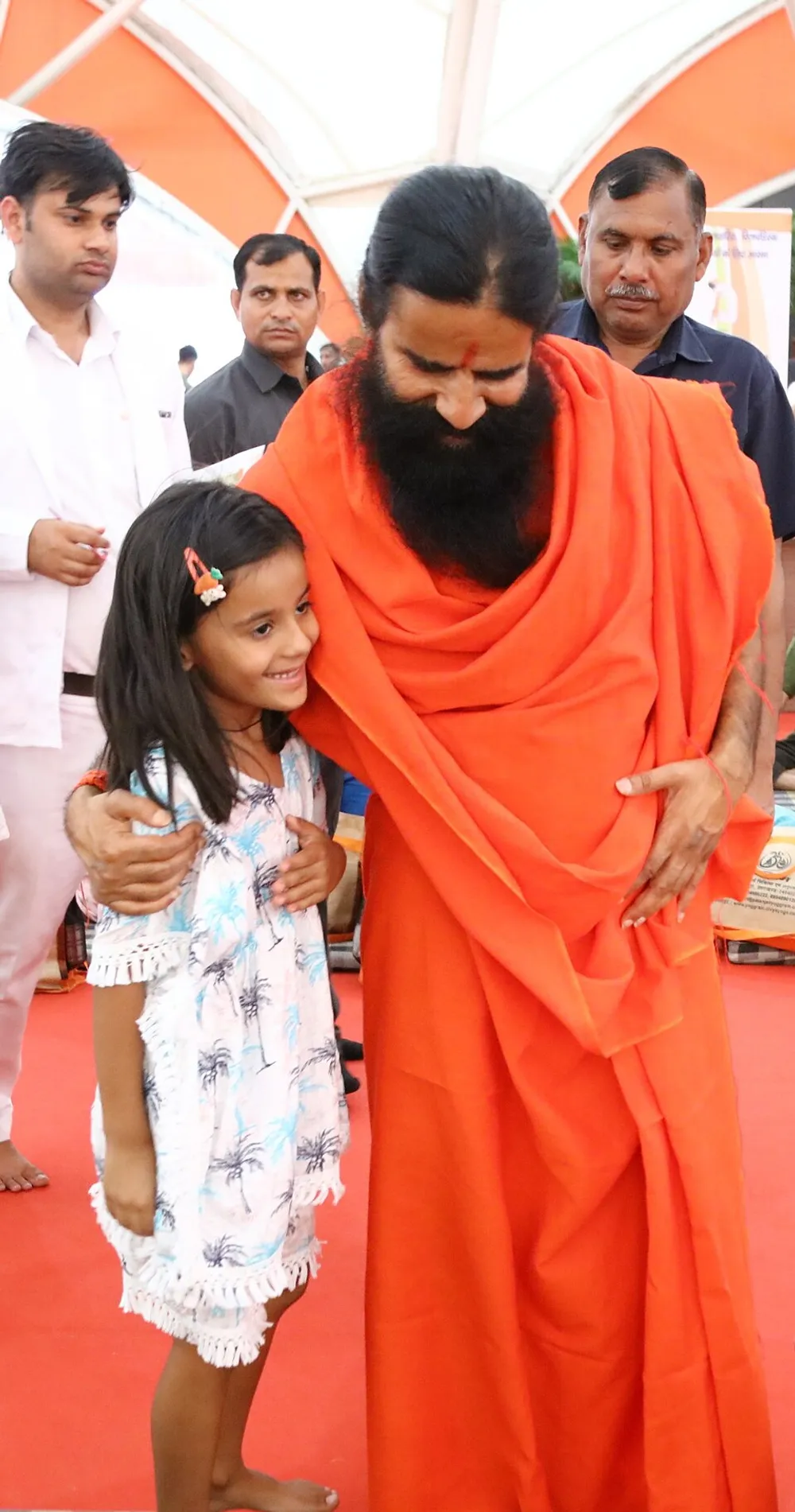
This profile is compiled from Ramdev's English Wikipedia article as maintained from its cited sources, cross-checked against the reported record of the Patanjali group and the court proceedings named above. The birth-name and family details (Ram Kisan Yadav; parents Ram Niwas and Gulabo Devi; Alipur village; brother Ram Bharat) come from the biographical literature cited in that article, and the uncertain birth range (1965-1975) is reported as a range because the record fixes no date. Contested claims (Coronil, the animal-matter allegation, the anti-allopathy remarks, the Rooh Afza case) are stated by what institutions did about them, the fines, court orders and withdrawn claims on record, and not as opinion. The portrait is the Wikimedia Commons CC0 file "Baba Ramdev.jpg," whose own description names him; the file currently used in the Wikipedia infobox was rejected because its Commons description does not identify the subject.