
In short: "Yadav" is today's umbrella name for a large family of historically pastoral and farming communities across South Asia, known regionally as Ahir, Golla, Idaiyar, Kunbi-Rao, Abir and by other names. Their origin story reaches back to Yadu, a king of the lunar dynasty in Sanskrit epic and Puranic literature, and to Krishna of the Vrishni clan, whose Yadava confederation is centred on Mathura and Dwarka in the Mahabharata. The verifiable historical record begins much later: Greek accounts around 300 BCE describe the Sourasenoi around Mathura, a c. 350 CE Gupta inscription names the Abhira, and a Deccan dynasty at Devagiri ruled as "Yadavas" in the 1200s. The single word Yadav that hundreds of sub-groups now share is the product of early-1900s community organising and colonial census consolidation. This guide covers all of those layers (legend, inscription, dynasty and modern identity) and separates them honestly.
Who are the Yadavs?
The Yadavs are one of the largest social formations in South Asia, spanning northern, western and southern India as well as the Terai region of Nepal. They are not a single, uniform caste in the strict sense. What the communities share is an origin story (descent from Yadu, and through him from Krishna) and a historical association with two occupations that ancient Indian texts treat as honorable: cattle- and cattle-product husbandry, and cultivation of the land. Many also carry a martial tradition recorded in inscriptions and chronicles.
Depending on the region, people inside this broad family may identify as Ahir (the Hindi belt, Rajasthan, Gujarat and Sindh), Golla (Andhra Pradesh, Telangana and Karnataka), Idaiyar or Ayar (Tamil Nadu and Kerala), Kunbi or Rao (Maharashtra and Karnataka), Abir (Nepal's Terai), or simply Yadav, a name that has spread fastest because it is the one the community's own twentieth-century organisations chose, and the one the census ultimately recorded. A useful starting point for the modern outline is the Yadav community's overview on Wikipedia, which collects the regional names and distribution that this article examines one by one.
What unites these groups is best described as a shared claim of origin. No documented single bloodline runs behind them, an important distinction that most popular retellings blur, and one we will keep returning to below.
Yadu: the ancestor of the story
Every Yadav genealogy starts with Yadu, a Vedic-era king whose name appears in the Rigveda among the five legendary sons of Yayati (the others being Turvasu, Druhyu, Anu and Puru). The Mahabharata and the Puranas (the Vishnu, Bhagavata and Vayu Puranas among them) expand the story: Yadu's descendants, the Yadavas, become a powerful confederation of clans in the western Gangetic plain and, later, of the Mathura region.
These texts are scripture and epic, not modern history writing, and we treat them as such. But they are also evidence of enormous value: they show that the idea of a Yadava people was already ancient when the earliest inscriptions mentioning their historical successors were carved. The genealogical literature names four principal Yadava houses (the Vrishnis, the Andhakas, the Bhojas and the Sattvatas) described in the Mahabharata as a confederacy ("Yuthayudha") whose members fought together and married among themselves.
Krishna and the Yadava confederation
The reason Yadu's name still carries weight is one man: Krishna. Born in Mathura's prison to Devaki and Vasudeva of the Vrishni clan, raised in the cowherd country of Gokul and Vrindavan among the pastoral people who would become central to Yadav memory, Krishna killed the tyrant Kamsa, became the leading figure of the Yadava confederation, and (according to the tradition) later established the city of Dwarka on the Saurashtra coast as the Yadava seat.
The Mahabharata's Mausala Parva then tells of the Yadavas' mutual destruction in a curse-driven brawl at Prabhasa, and of Dwarka going under the sea, a moving endpoint that communities remember as the close of an age. Whether read as theology, memory, or proto-history, this is the core from which Yadav identity has drawn for well over two thousand years. The related clans are covered individually in the Vrishni clan's encyclopedia entry, one of the four houses above.
Three cultural details from this cycle remain alive in Yadav households today: the worship of Krishna's childhood (the Laddu Gopal tradition of Braj), the reverence for the cow as the animal of Krishna's community, and the pride in Dwarka as the civilisation's high-water mark.
The earliest hard historical records
Legend aside, when does the historical record actually name these people?
- c. 300 BCE: Greek accounts. Megasthenes, the Greek ambassador at the Mauryan court, described (in quotations preserved by later writers) a people called the Sourasenoi (the Shurasena, of the Mathura region) who worshipped a hero the Greeks equated with Herakles. Most historians accept this as a reference to Krishna-Vasudeva worship, which would make the Krishna-centric Yadava memory already two and a half millennia old as recorded history.
- c. 350 CE: the Allahabad Pillar. Samudragupta's prashasti at Prayagraj lists the Abhira among the tribal republics (alongside the Malavas, Arjunayanas and Yaudheyas) on the frontier of the Gupta empire. This is the earliest surviving inscription bearing the name Abhira, widely identified with the Ahir herders and warriors of later centuries. Sanskrit Abhira ("fearless") became Prakrit Ahir, a standard example of how vernacular identities evolve from classical ones; the Abhira entry summarises the epigraphy.
- 5th to 7th centuries. Puranic king-lists anticipate Abhira rule after the Guptas, and a high official named Kharapallana in a 634 CE inscription from the reign of Harsha is read by a number of historians as an Abhira, which hints that Abhira chieftains were entering polities, not just pasturing on their edges.
- Early medieval period. Ahir communities are visible across a wide arc: as landholders and pastoralists in Rajasthan and Braj, as rulers of small fortified territories (the "Ahirwal" belt around Rewari and Nuh persists as a name to this day), and as fighters in the shifting armies of the Sultanate and Mughal centuries. In 1669, Ahirs joined Jats and other cultivating communities in the uprising around Tilpat against Aurangzeb's governorship, one of many episodes that built the community's martial reputation, later recognised by colonial recruitment patterns.
The honest summary: from the mid-first millennium BCE, texts remember a Yadava people around Mathura; from the mid-first millennium CE, inscriptions name their historical successors, the Abhira/Ahir, across north and west India.
The Yadava dynasty of Devagiri (c. 1187–1317)
The most spectacular single argument for the prestige of the Yadava name is that an important Deccan kingdom adopted it. The Seuna (Yadava) dynasty, ruling from the fortress-capital of Devagiri (Daulatabad, near modern Aurangabad) from the late 12th century, claimed descent from the Yadus of legend and patronised the Bhakti saint Jnaneshwar. Under kings such as Singhana, the Yadavas of Devagiri controlled much of the Deccan, until Malik Kafur's raids of 1308 began extracting tribute, and the dynasty was absorbed into the Delhi Sultanate in the 1310s. The dynasty's rise and fall is documented in the Yadava dynasty entry, and our own long-form account of the kingdom, its kings and its end is on The Yadava Dynasty of Devagiri.
Historians draw a careful line here: the Devagiri Yadavas were a Maratha-speaking royal house asserting a Puranic genealogy for legitimacy, which is precisely what many rising dynasties did across India (Rajputs traced solar and lunar lines; Cholas and Pandyas traced theirs to epic heroes). The claim made the dynasty prestigious; it does not, by itself, prove that every Yadav/Ahir community descends from a single historical family. That is the distinction the rest of this article keeps honouring.
How many names, how one community
The clearest way to understand Yadav origins is to see them as a convergence. Across centuries, pastoral and farming communities in different regions independently looked at the same Sanskrit sources and concluded they belonged to the same people:
| Region | Names used | Historical note |
|---|---|---|
| Uttar Pradesh, Bihar, MP | Yadav, Ahir, Rao | Rao as an honorific title; "Yadav" now dominant |
| Rajasthan, Haryana (Ahirwal), Gujarat | Ahir, Yaduvanshi | Strong landholding and martial tradition |
| Maharashtra, Karnataka | Kunbi-Rao, Yadava, Maratha-Yadav | Overlaps with the Deccan Yadava legacy |
| Andhra Pradesh, Telangana | Golla (Golla-Saivaru, Ontari) | Pastoral Golla and weaving sub-groups |
| Tamil Nadu, Kerala | Idaiyar, Ayar | Milk-product traders; temple associations |
| Nepal Terai | Abir, Dhanushkhari | Census-recognised as Adharmik/Abir communities |
Surnames and titles follow the same pattern: Yadav, Ahir, Rao, Vrishni (carried even by Ahir diaspora families from Sindh and Karachi), Saini (a community tracing itself to the Shurasena region of the Yadava heartland), Golla and Idaiyar. Many families with these surnames today have no documented link to one another, and that is exactly the point. A shared origin story can unite many real histories without erasing their distinctness.
Where do Yadavs live? Distribution across India and Nepal
Direct answer: Yadavs live across most of India and in the Terai belt of southern Nepal, with the largest concentrations in the northern Indo-Gangetic states (Uttar Pradesh and Bihar) and heavy populations in Madhya Pradesh, Rajasthan, Haryana, Gujarat and Maharashtra, plus related communities under regional names (Golla, Idaiyar, Ayar) across the Deccan and the deep south. Because independent India has never run an all-India caste census, there is no single authoritative national headcount; what the available records consistently show is a spread that is near-universal geographically but demographically heaviest on the northern plain.
The pattern tracks two things: the historical pastoral-and-farming belt of north and west India, and, in the south, the milk-trading Golla and Idaiyar communities. Regional presence, with the indicative markers used by the sources cited below:
| Region / State | Concentration | Indicative note |
|---|---|---|
| Uttar Pradesh | Highest | Largest Yadav population of any state; central to state politics |
| Bihar | Highest | Yadav/Ahir among the state's biggest OBC jatis in the 2023 caste survey |
| Madhya Pradesh | Very high | Yaduvanshi and Ahir communities across the Gangetic and Malwa zones |
| Rajasthan, Haryana (Ahirwal) | High | Landholding Ahir belt; "Ahirwal" around Rewari and Nuh survives as a place-name |
| Gujarat | High | Ahir pastoral and farming communities |
| Maharashtra | High | Ahir / Kunbi-Rao; legacy of the Devagiri Yadavas |
| Andhra Pradesh, Telangana, Karnataka | Significant | Golla pastoral communities |
| Tamil Nadu, Kerala | Significant | Idaiyar / Ayar milk-trading communities |
| Nepal (Terai) | Significant | Abir / Dhanushkhari communities, census-recognised |
Joshua Project's people-group profile, for instance, records "more than 12 million" Yadav in Bihar alone and places the highest overall concentration in Uttar Pradesh and Bihar, figures to read as order-of-magnitude estimates, not a census. The dependable conclusion is geographic, not numeric: Yadav, Ahir, Golla or Idaiyar presence exists in nearly every Indian state, but the community's demographic and political weight is greatest on the northern plain, which is exactly why Yadav names dominate the politics profiled in our political biographies section.
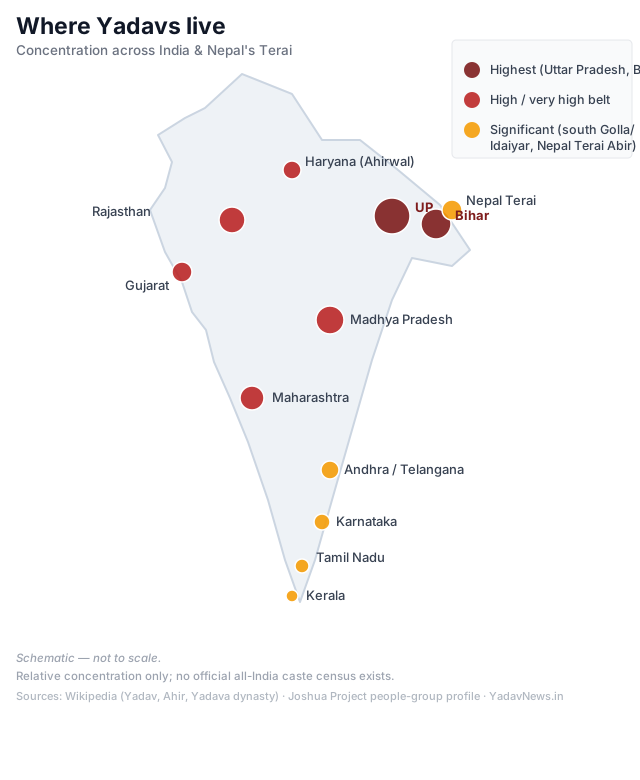
Figure: relative Yadav/Ahir concentration, drawn schematically (not to scale). Circle size follows the sources above, not an official census count, because no all-India caste census exists.
From Ahir to Yadav: how a census built an identity
The final act of the story is modern, well documented, and frequently misunderstood.
In the late 1800s, colonial ethnographers such as H.H. Risley treated Ahir, Golla, Kunbi, Idaiyar and dozens of similar jatis as separate (if vaguely related) occupational groups. Beginning around the 1890s and accelerating through the 1900s and 1920s, community associations held conferences across the United Provinces, Bombay Presidency and Bihar. Their programme had two parts: adopt the Sanskritic name Yadav tied to the Krishna genealogy, and persuade the census (the new state's master record of society) to record them that way.
The organising body that gave this movement its national shape, the All India Yadav Mahasabha, worked through the 1920s and 1930s at exactly the moment census officials were debating how to classify India's pastoral castes. The decisive administrative judgement came from O.C. (Orme Chand) Mandal of the Census of India, who (drawing on the communities' own claims and the Puranic literature) recommended that the Ahir, Golla, Kunbi and allied groups be returned under the single entry Yadav in the 1931 census. Mandal went on to become Director-General of Census Operations and, later, a founder-pracharak of the RSS; whichever lens one uses, his 1931 classification was the hinge on which the modern name swung into place.
Several provinces duly merged the sub-group names. Independent India's backward-class schedules then recorded "Yadav" (often alongside "Ahir/Golla") as an OBC category in state after state, freezing the consolidated name in law, scholarships, and politics even as local usage kept the older regional terms. Bihar's 2023 caste survey, for instance, counted Yadavs among the state's largest OBC jatis under that consolidated label.
So the truthful answer to "where do Yadavs come from?" has two halves. From a historian's desk: from many real pastoral, farming and warrior communities of the subcontinent, some of them visible under the name Abhira/Ahir for over sixteen centuries. From the community's own memory: from Yadu and Krishna, a tradition so old that the Greeks recorded its shrines. The name that makes both answers share one word was finalised a little over ninety years ago.
Yadavs in public life today
Because the consolidated identity arrived just as mass politics did, Yadav names are now woven through every field the YadavNews fact-checking desk covers.
In politics, Mulayam Singh Yadav and Lalu Prasad Yadav built the two parties that turned OBC assertiveness into the defining fact of Uttar Pradesh and Bihar politics; their successors, Akhilesh Yadav (India's youngest chief minister at his first swearing-in) and Tejashwi Yadav, Bihar's youngest deputy chief minister, are profiled in our political biographies section.
In cricket, Suryakumar Yadav, India's destructive modern T20 batsman, whose captaincy in the format we covered when he was named T20 captain, and Kuldeep Yadav, India's leading left-arm wrist-spinner, both carry the surname into the world's largest stadium sport; our cricketer profiles track them with verified records.
In entertainment, comedian-actor Rajpal Yadav and reality-TV breakthrough winner Elvish Yadav represent generations of the community's presence in screen culture, collected in our entertainment profiles.
(These are all part of YadavNews's core mandate: documenting prominent personalities of the community with sources, dates and corrections policies you can read in our editorial policy. Read this history in Hindi in the Hindi edition of the origins article.)
Festivals, symbols and everyday heritage
Yadav cultural practice centres naturally on the Krishna cycle: Janmashtami (Krishna's birth, kept with midnight worship, fasting and jhoola/cradle rituals), Govardhan Puja and Annakut (Krishna lifting the hill, with mountains of food offerings), Gopashtami (the cow-herding festival, most directly tied to the pastoral vocation), and the Braj region's Holi, including the lathmar tradition of Barsana. The flute, the peacock feather, the cow and the pot (Krishna's iconography) are Yadav household iconography. Community shrines and ghats of Dwarka, Mathura, Vrindavan and Gokul remain the pilgrimage spine, and the Yaduvanshi flag and emblem traditions carried by Mahasabha-era organisations formalised these symbols in the twentieth century.
Three misconceptions worth clearing
- "Yadav is one caste." It is a large cluster of endogamous jatis: an Ahir family of Ahirwal, a Golla family of Guntur and a Kunbi family of Satara were, for most of history, distinct communities who chose (and keep choosing) a shared name and a shared story.
- "The Devagiri Yadavas are the direct ancestors of today's Yadavs." The dynasty proved the Yadava idea's prestige; modern communities' link to it is genealogical aspiration, documented nowhere. The same care applies to claims about Krishna's historical historicity: tradition, inscription and archaeology tell three compatible but different stories.
- "The name was always Yadav." Inscriptions say Abhira; vernacular history says Ahir, Golla, Idaiyar; "Yadav" as a mass identity is barely a century old. Knowing this weakens nothing, it shows the community consciously wrote its own entry into modern history.
Conclusion: why the origins matter
A community that can read its own layered past (epic, inscription, kingdom, census) is better equipped to debate its present: reservation rosters, caste surveys, political arithmetic, and the endless online arguments about who "really" descends from whom. YadavNews will keep covering that argument with sources, dates and named authors. If you spot an error in this article, our corrections policy explains how we fix it and how fast.