Biography & Career Overview
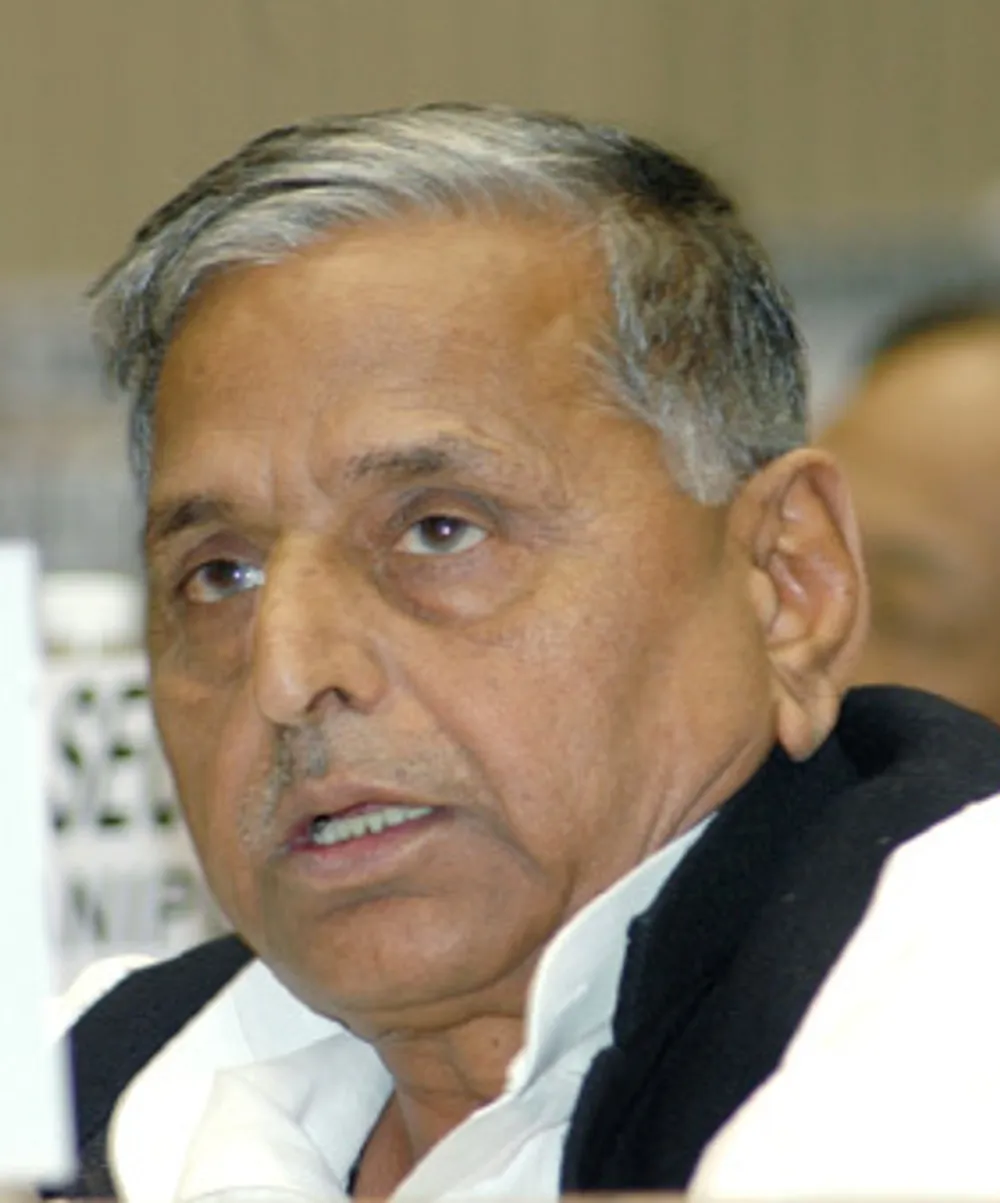
Mulayam Singh Yadav (22 November 1939 - 10 October 2022) was among the longest-serving and most consequential politicians of North India, and the founder of the Samajwadi Party (SP), the formation that turned the Yadav vote, the Muslim vote and the wider Other-Backward-Class (OBC) vote of Uttar Pradesh into a durable electoral force. A schoolteacher by training and a peasant leader by instinct, he was known to millions by the honorific 'Neta Ji' (the Leader) and to his own cadre as the unquestioned patriarch of a political dynasty now carried forward by his son Akhilesh Yadav. He served three separate terms as Chief Minister of Uttar Pradesh, India's most populous state, and held the Union Defence Ministry. His five-decade career is inseparable from how a numerically large but socially subordinate community, the Yadavs, took political power in the Hindi heartland. This profile documents that public record from named, dated sources.
Early Life: A Village Schoolmaster from Saifai
Mulayam was born on 22 November 1939 in Saifai, a village in what is now Etawah district of western Uttar Pradesh, into a farming family of the Yadav (pastoral/backward-caste) community. His father was Sughar Singh Yadav and his mother Murti Devi, names carried consistently in the family profiles published at his death by OneIndia, Hindustan Times and Jagranjosh. He took three degrees, all in the same discipline: a B.A. from Karm Kshetra Post Graduate College in Etawah, a B.T. (Bachelor of Teaching) from A.K. College in Shikohabad, and an M.A. in political science from B.R. College under Agra University. That three-degree list is not aggregator folklore; it is the qualification line the Uttar Pradesh Legislative Assembly publishes for him among its former chief ministers. He began his working life as a schoolteacher and lecturer. He never fully left that profession behind rhetorically: his plain, classroom-direct Hindi and his habit of explaining politics as a moral lesson between the "have-nots" and the elite were the habits of an instructor. This rural, pedagogical beginning set him apart from the English-speaking, dynastic politicians of the Congress era and became the foundation of his mass appeal. He married twice. His first wife was Malti Devi, married to him from 1957 until her death in 2003 and the mother of his son Akhilesh Yadav. His second wife was Sadhana Gupta, whom he married in 2003 and who died in July 2022; the connection had become public record when it was acknowledged before the Supreme Court of India in February 2007. Their son Prateek Yadav died in May 2026.
Entry into Politics: From Lok Dal to the Janata Upheaval
Mulayam entered politics in the 1960s and 1970s within the socialist, peasant-oriented tradition of Charan Singh's Bharatiya Lok Dal, riding the wave of agrarian, anti-Congress, backward-caste mobilisation that swept western and northern Uttar Pradesh. His first electoral victory came in 1967, when he won the Jaswantnagar seat of the Uttar Pradesh Legislative Assembly on Ram Manohar Lohia's socialist ticket (Times of India; Britannica), and the state assembly's own record of his memberships carries Jaswantnagar again in 1969 and then in 1974 and 1977. He rose through the turbulent opposition politics of the 1970s, aligning with the Janata experiment that briefly unseated Indira Gandhi's Congress in 1977. When the Janata fold fragmented he stayed with the Janata Dal, and by the late 1980s he was the dominant face of the party in Uttar Pradesh. He entered the Union Cabinet only in 1996, when he became India's Defence Minister.
Chief Minister and the Ram Janmabhoomi Crucible
The most charged episode of the Ram Janmabhoomi era fell on Mulayam as the head of the Uttar Pradesh government, which is why history records it against him personally. In 1990, when Sangh Parivar and Vishwa Hindu Parishad supporters reached Ayodhya and marched towards the disputed site where the Babri mosque stood, the state government he led put the police and paramilitary forces in their way, and firing killed kar sevaks; the official records of his own government put the number of marchers killed at at least 17. He insisted that the state would not capitulate to the agitation. The fallout reshaped the politics around him: the BJP withdrew its support from V. P. Singh's Union government, and mid-term assembly elections in 1991 cost Mulayam his own government. To Hindu-nationalist opponents he became the man who had fired on kar sevaks. To his OBC and Muslim constituency he became the leader who had stood up to the mobilisation, and that reading of 1990 hardened his alliance calculus for the rest of his career. He held the Union Defence Ministry later, from June 1996 to March 1998 in the United Front governments of H. D. Deve Gowda and I. K. Gujral, taking the charge from Pramod Mahajan and passing it on to George Fernandes. When the mosque was demolished in December 1992 under a different state government, he returned to power the following year at the head of a Samajwadi Party and Bahujan Samaj Party coalition.
Founder of the Samajwadi Party (1992)
When the Janata Dal broke apart, Mulayam took his faction and in 1992 founded the Samajwadi Party, a socialist, backward-class, secular formation built on a "Mandal" (social-justice) constituency of OBCs and Dalits joined by Muslims, and arrayed against upper-caste and Congress dominance. The party's own record puts him in its presidential chair from October 1992. The SP became the institutional vehicle of Yadav political assertion in Uttar Pradesh, mirroring in the largest state what Lalu Prasad Yadav's Rashtriya Janata Dal was doing in Bihar. Its cadre culture was overtly caste-arithmetic and often thug-tolerant, but its social core, the giving of self-respect and state power to the "pitthu" (the common man), was real, and it is why the surname "Yadav" itself became electorally potent. This arc is the political chapter of the wider story told in the origins of the Yadav community.
Chief Minister of Uttar Pradesh: Three Terms
Mulayam served as Chief Minister of Uttar Pradesh three times, and the dates of those terms are the spine of his career record. The first ran from 5 December 1989 to 24 June 1991: a Janata Dal government dependent on Congress support, which fell once Congress withdrew that support in April 1991 and mid-term elections handed power to the BJP. The second began on 5 December 1993, at the head of the Samajwadi Party-Bahujan Samaj Party coalition assembled after the Babri demolition, and lasted until 3 June 1995. The third, from 29 August 2003 to 13 May 2007, was his only full term, and it started with an oddity: he was sworn in while still a sitting member of the Lok Sabha and, to meet the constitutional requirement of entering the state legislature within six months, won the Gunnaur by-election in January 2004 by a record margin of 1,83,899 votes, polling 90.45 per cent of the vote. That government is remembered on one hand for its populism, free or subsidised electricity and aggressive rural outreach, and on the other for a law-and-order record his critics called "jungle raj," with the SP accused of patronising its cadre and of softness toward crime. His own blunt, much-quoted defences of party men ("boys will be boys," and his reluctance to register cases against supporters) became defining controversies of that term. He never led a government again. After the 2012 assembly election it was his son Akhilesh who became Chief Minister, while Mulayam kept the real authority in the party, which made him, in his seventies, the most decisive figure in the state's politics until the SP's defeat in 2017.
In the Lok Sabha: Mainpuri, Sambhal and the Last Term
The national mandate came late and then repeatedly. He contested a Lok Sabha seat for the first time in 1996 and won Mainpuri, which is how he took the Defence Ministry in the United Front government (Times of India career timeline). He returned to the Lower House in 1998 from Sambhal, and Mainpuri sent him back in 2004, 2009 and 2014 (Business Today). His last term was won in April-May 2019, when IndiaVotes records him polling 5,24,926 votes, or 54.13 per cent, to defeat the BJP's Prem Singh Shakya at 4,30,537 votes and 44.39 per cent, a margin of 94,389 votes, derived here by subtracting the two published totals, not quoted from any source. He was therefore the sitting member for Mainpuri when he died on 10 October 2022, and the by-election to fill that vacancy was held in November and declared on 8 December 2022, when the Samajwadi Party retained the seat through his daughter-in-law Dimple Yadav on a margin the press agencies reported at over 2.8 lakh votes (The Print; Times of India). The seat, in other words, passed from Mulayam to the family account rather than to the opposition.
The 2019 return also produced the only rupee figure this page prints. His election affidavit, archived by MyNeta from the Election Commission record and read out in the press when it was filed, declared movable and immovable property totalling ₹16.52 crore - roughly 3.20 crore less than what he had declared five years earlier - and disclosed that he owed ₹2.13 crore to his son Akhilesh Yadav (Hindustan Times; NDTV). Loans between family members are routine in Indian affidavits and implicate no one on their own; the reason to print the number at all is that readers searching a political name will find it quoted without its year or its source.
Later Years, Succession Struggle and Death
Mulayam's final decade was marked by the tension between being a patriarch and remaining a functioning leader. He led the SP through the 2014 Lok Sabha rout, when the party was nearly wiped out by the BJP's wave, and in 2017, after the SP lost the assembly election, he publicly sought forgiveness from his own supporters. The rupture with his son came that same year, and it was over the party, not the government. At a national executive convention convened by Ram Gopal Yadav on 1 January 2017, Akhilesh was confirmed as party president and Mulayam was moved sideways into the newly created post of chief patron. Mulayam called the convention illegal and expelled Ram Gopal Yadav; the Election Commission then ruled that Ram Gopal Yadav had been entitled to convene it, reversed Mulayam's expulsion order, and left Akhilesh the party's recognised national leader. The family had already divided into two feuding camps from 2012, when Akhilesh became Chief Minister by surpassing Mulayam's brother Shivpal Singh Yadav, and Mulayam spent his last years as the figure both sides claimed. He held the title of the SP's guidance leader from January 2017 until his death. Mulayam Singh Yadav died on 10 October 2022 at Medanta hospital in Gurugram, Haryana, at the age of 82. He was cremated with full state honours, and his samadhi is at Saifai, the village from which he began.
Why He Matters to This Archive
If Suryakumar and Kuldeep Yadav carry the Yadav name into international cricket, it is Mulayam Singh Yadav (alongside Lalu Prasad Yadav) who made "Yadav" a word that moves governments in India. His career is the template for the community's political self-assertion in Uttar Pradesh, for better (social justice, backward-class dignity, the bicycle that carried his son to the chiefministership in 2012) and for worse (caste polarisation, thug tolerance and the law-and-order failures of his middle years). YadavNews documents that whole record with sources, not hagiography or caricature; this profile sits within the politicians archive and the verified guide to notable Yadav personalities.
How This Profile Was Verified
Dates of birth and death, offices held, terms as Chief Minister, the founding of the Samajwadi Party and the family relationships above were cross-checked on 3 October 2026 against the parliamentary and biographical record summarised in the sources listed below, and against the Election Commission findings that record recounts. Contested characterisations (the 1990 firing on the kar sevaks, the "jungle raj" critique of 2003-2007 and the 2017 party convention) are reported as competing claims attributed to their sources, not adjudicated. A correction log matters on a page like this one: an earlier version of this profile named his wife Madhavi Yadav, listed a daughter, gave him a Railways portfolio in 1989 and dated his first chiefministership to 1994-1995. None of that survives this revision. The record we now follow gives two wives, Malti Devi and Sadhana Gupta, three terms as Chief Minister beginning in 1989 and closing in 2007, and a Defence Ministry held from 1996. The 2026 additions on this page carry their own provenance. The parents' names come from the family profiles published at the time of his death; the three degrees are read from the former-chief-minister biography the Uttar Pradesh Legislative Assembly publishes on its own proceedings site; the 1967 Jaswantnagar win and the 1996 and 1998 Lok Sabha entries follow the career timeline Times of India published when he died, checked against Britannica; the 2019 Mainpuri vote totals are the figures on the IndiaVotes result page for that constituency, and the 94,389 margin is our own subtraction of those two published numbers, labelled as derived wherever it appears; the asset figure is the one archived from his 2019 affidavit by MyNeta and reported by Hindustan Times and NDTV; and the December 2022 by-election result is from Times of India and The Print. All of it was re-read on 4 October 2026.
Two attributes are deliberately left unset rather than filled. No civilian award or state honour is documented for him in the record reviewed here, so this page prints none, whatever commemorative distinctions announced in his name after October 2022 may later prove to be. And no verified first-person social media account appears in that record: the handles that post in his name are party or family-run, and pointing one of them at him personally would be a guess, not a fact.
Our continuing third-party cross-check is the Mulayam Singh Yadav article on Wikipedia, with the Samajwadi Party article for the party's founding; working facts are drawn from the underlying primary record. Corrections can be requested via the corrections policy.