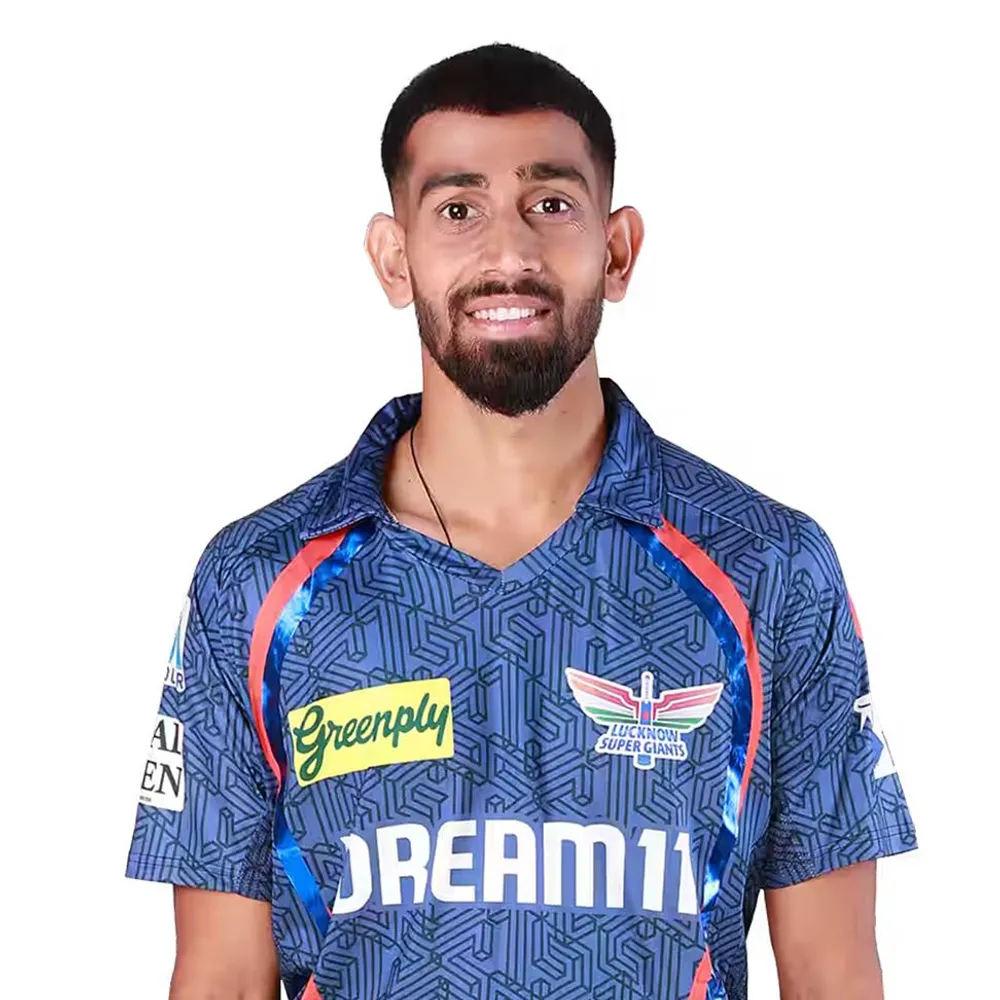
Biography & Career Overview
Prince Yadav's career is a study in how late a talent can bloom and still arrive early, and in the reason it bloomed late. Born on 12 December 2001 in Delhi and raised in a village on the capital's southwestern edge, he had played nothing but tennis-ball cricket until he was seventeen, and in December 2019 the BCCI banned him for two seasons after finding he had falsified his age to play Under-19 cricket. He was a first-class debutant at twenty-two as a consequence of those lost years, an age at which most Indian international prospects have already passed through the auction room with a highlight reel behind them, and within eighteen months of that debut he had played for India in both limited-overs formats. In between, he became one of the discoveries of the 2024–25 domestic season, a ₹30 lakh pick at the IPL mega auction on the strength of a single T20 tournament, Delhi's highest wicket-taker in the Syed Mushtaq Ali Trophy, a regular for the Lucknow Super Giants, and, by the middle of 2026, an ODI and T20I international. His T20I debut produced one of the most quotable facts a fast bowler can carry: on the first ball he ever faced in the format, he hit a six, joining a list of Indians containing exactly two other names, Suryakumar Yadav and Ramandeep Singh. He is one of two Yadav quicks currently in the Lucknow Super Giants camp alongside Mayank Yadav, and his arc from the Delhi Premier League to the national team is the cleanest recent example of Indian selectors reading domestic data ahead of reputation.
Early Life: A Village Near Najafgarh, Tennis-Ball Cricket, and a Club Coach
Prince grew up in Dariyapur Khurd, a village on the southwestern edge of Delhi in the Najafgarh area, and the cricket he played there was the tennis-ball game of the mohalla grounds, not the leather-ball age-grade circuit. ESPNcricinfo and its January 2026 feature record that he had not touched a leather ball until the age of seventeen; The Delhi Junction described him on 9 January 2025 as a 23-year-old pace bowler from the Najafgarh area. His coach has said the yorker that later made his name is a tennis-ball habit, not a coached one (The Delhi Junction, 19 May 2026).
The doorway into organised cricket was a club, not a school team. The Hindu reported on 30 April 2026 that Amit Vashisht, a coach who had been running Delhi's Sporting Cricket Club for nearly two decades, happened to be watching a tennis-ball game and noticed him; the Times of India credited the former Delhi cricketer Lalit Yadav with picking Prince and insisting he join an academy some fifteen kilometres from home. ESPNcricinfo's account is that within a year of joining an academy Prince reached Delhi's Under-19 team. Vashisht has spoken publicly about the journey since the India call-up, as PTI reported.
His father did not want any of it. Ram Niwas Yadav, a retired Assistant Sub-Inspector of the Railway Protection Special Force, spent years trying to pull his son out of cricket and into a government job: he made Prince apply for recruitment to the Delhi Police and for several Group D posts, and there were times when Prince failed the written stages (Indian Express, 19 May 2026; Times of India via Yahoo, 20 May 2026). The Indian Express's feature on 21 April 2026 called him the "bigda hua" son his father tried to stop, and reported Ram Niwas as having "spent years counting reasons his son would fail". When the Lucknow Super Giants signed him, the same father's fear changed shape: Dainik Bhaskar's English desk reported him as nervous at the names on the list. On the afternoon India named him, Ram Niwas was out buying groceries (Times of India).
The years his father wanted written off were, in fact, written off on paper. On 2-3 December 2019 the BCCI sanctioned Prince Ram Niwas Yadav, then a Delhi player, for two seasons for age-fudging in Under-19 tournaments, disqualifying him with immediate effect from BCCI events (Cricbuzz, 2 December 2019; Times of India, 3 December 2019, which records the punishment as the 2020-21 and 2021-22 seasons). ESPNcricinfo's January 2026 feature dates the ban to December 2020 and adds that the board also ruled he could play only senior cricket once it expired; the Times of India's 2026 profile says he was eighteen at the time and had cut four years off his papers. This profile reports the sanction and the disagreement about its date rather than settling either. What the lost seasons explain is the shape of the record: a bowler whose first-class debut came at twenty-two, three years after the ban was imposed.
What is documented next changes in the 2024 season of the Delhi Premier League T20, the city's franchise tournament that functions as the last shop-window before the national selectors' eyes reach the official circuits. Prince played for Purani Delhi 6, the side led by Rishabh Pant, and finished the season with thirteen wickets in ten matches. The performance was not merely a tally; it was the kind of white-ball apprenticeship (new-ball spells, death-over concessions, home conditions) that a state team notices before an IPL camp does. Following that season he earned his white-ball call-up for Delhi, having already represented the state in the Ranji Trophy, and the sequence of doors that opened across the following eight months is the substance of his record.
Domestic Breakthrough: Three Debuts, One Statement Season
Prince made his first-class debut for Delhi against Jammu & Kashmir in the 2023–24 Ranji Trophy on 12 January 2024, the longest-format entry that preceded his white-ball rise. His T20 debut followed for Delhi against Uttar Pradesh on 23 November 2024 in the 2024–25 Syed Mushtaq Ali Trophy, a date that sits in memory because it was the day before the 2025 IPL mega auction. In that match he picked up two crucial wickets to seal a Delhi win, and on the following day the Lucknow Super Giants selected him for ₹30 lakh. The auction timing made the story neat, but the season that followed made it durable: he finished the Syed Mushtaq Ali Trophy with eleven wickets at an economy rate of 7.54, the highest wicket-taker on the Delhi side, which itself reached the semi-final. A bowler who is bought the day after debuting and then leads his state's tournament wicket charts is a bowler whose auction price was the bargain, not the achievement. He completed the domestic triangle with his List A debut for Delhi against Bengal in the 2024–25 Vijay Hazare Trophy on 21 December 2024, ending that season with eleven wickets in six matches at an average of 22.00.
IPL Career: From Retention to the Purple Cap Conversation
Prince made his Indian Premier League debut for the Lucknow Super Giants against the Delhi Capitals on 24 March 2025, the fourth match of the tournament, and finished his first IPL season with three wickets in six matches, a rookie's return that nonetheless earned him retention in the Lucknow squad for IPL 2026. The 2026 season is where the numbers turned. He took sixteen wickets in fourteen matches at an average of 28.69 and an economy rate of 8.83, with best figures of 3/32 against Royal Challengers Bengaluru, and finished as the franchise's leading wicket-taker, per the Super Giants' own player profile. Along the way, a run of wickets in the opening weeks had him leading the league's Purple Cap standings, by the reporting of mid-May, which moved him from squad player to the shortlist of Indian cricket's most-watched new quicks. The single delivery that did most of that work was a yorker that bowled Virat Kohli for Lucknow against Royal Challengers Bengaluru in Lucknow in early May 2026, which ESPNcricinfo raised on 7 May 2026 to "the ball of the tournament", with Ambati Rayudu quoted saying the seam had stayed up on a wicket that mattered because it was Kohli's. Yahoo-Republished reporting noted on 28 June 2026 that the India cap followed that dismissal, and that his first wicket in T20I cricket was the Ireland captain Lorcan Tucker. The Purple Cap position in any IPL season is a moving object; what is fixed is that across twenty IPL matches he has taken nineteen wickets, in the same dressing room as Mayank Yadav, the fastest bowler in the league's recent memory.
International Career: ODIs, T20Is, and a Six on the First Ball
The national call came in May 2026: his maiden India selection, for the ODI series against Afghanistan. He made his ODI debut in the second match of the series on 17 June 2026 at Lucknow, in an innings remembered for the moment his first international wicket was struck out on a marginal no-ball review before he took another. He has played three ODIs, all in 2026, the last of them against England at Lord's on 19 July 2026, and has taken four wickets. Within the same month he was included for the two-match T20I away series against Ireland, and on 28 June 2026, in the second match, he made his T20I debut, and the debut delivered the statistic that travels. On the first ball he faced in international T20 cricket, as a number-eight type batter whose job description is the lower middle order, Prince hit a six. In the entire history of Indian T20 Internationals, only Suryakumar Yadav and Ramandeep Singh had previously done that. For a reader of this archive, the connection is literal: Suryakumar Yadav is the benchmark batsman of the Yadav name, and Prince Yadav now shares one of his strangest records. He has taken nine T20I wickets in six matches at an average of 18.78. The two caps in one month, earned at twenty-four off three seasons of domestic cricket, completed one of the faster domestic-to-international conversions an Indian quick bowler has made.
Playing Style: New-Ball Seam at the Front of the Attack
Prince is a right-arm fast bowler whose value to Delhi and Lucknow has been built on the new ball: an upright seam position, hits the good length hard enough to keep batters on the back foot, and moves the off-cutter and slower ball through the same arm speed. The wicket tallies describe the method better than adjectives, eleven wickets in a winning Syed Mushtaq Ali campaign for Delhi, eighteen in the following Vijay Hazare season, sixteen in fourteen IPL matches in his second league year, the economy figures in the sevens and eights instead of the tens that mark a bowler trusted with the powerplay and the death in equal measure. His batting, the lower-order strike that produced the debut six, is a genuine extra: a bowler who can clear the ropes against quality international bowling changes the arithmetic of a number-eight slot. The limitations that belong to the same profile are those of any young quick, workload management, and the consistency question that follows a bowler whose first two seasons at the top level were separated by a single summer.
Personal Life: Family, Name, and What Is Not on Record
The personal record here is thinner than the cricket but real, and an earlier version of this profile said it did not exist. Prince's full name as printed in the 2019 sanction reporting is Prince Ram Niwas Yadav, with the middle name his father's: Ram Niwas Yadav, a retired Assistant Sub-Inspector of the Railway Protection Special Force (Indian Express, 19 May 2026). His mother is Santosh Yadav, named with his father in ESPNcricinfo's caption to the PTI photographs of the couple reacting to their son's first India call-up at Lucknow on 20 April 2026. The family's home is Dariyapur Khurd in the Najafgarh corner of Delhi.
What is not on the record is stated plainly. No outlet consulted for this profile reports a marriage, a partner, children, siblings, a school leaving certificate or a college degree, and this archive invents none of them; the biographical PDFs and social-media compilations that circulate under his name give a different father's name and a sister, and they are excluded because they are user-uploaded and contradict the named reporting on the father. His public social presence tracks his cricket, not his private life. An Instagram account under his name, whose own bio tags the Lucknow Super Giants, is listed in this profile as unconfirmed: its ownership rests on that team tag, not on a platform verification mark this archive has been able to read. What remains verifiable is the shape of the rise: a tennis-ball village childhood, an academy in his late teens, two seasons lost to a sanction, a Delhi Premier League season under Rishabh Pant's leadership, an auction purchase the day after a T20 debut, and two international caps inside a month at twenty-four.
His Place in the Yadav Story
Prince Yadav adds a second Delhi fast bowler to the Yadav cricket shelf beside Mayank Yadav, and links his name to Suryakumar Yadav through the T20I first-ball six record the two now share with Ramandeep Singh. Within the archive's cricket section he is the counter-example to the pipeline story: Umesh Yadav, Mayank Yadav and Mangesh Yadav came through the state age-grade system that produces Indian quicks on schedule, while Prince came in from tennis-ball cricket at an age the age-grade system had finished recruiting, and then lost two of his scheduled seasons to a sanction. One name in his coaching history needs a caveat. The Times of India credits his discovery to a former Delhi cricketer named Lalit Yadav; this archive keeps a full profile of Lalit Yadav, the Delhi-born all-rounder of the 2020s, but no consulted source states that the two references are the same person, so the names are recorded side by side and deliberately not joined. The cricketers hub collects the Yadav profiles in full, and the long-read origins of the Yadav community supplies the social backdrop. Where an outside source disagrees with our record, the corrections policy explains how we resolve it.
How This Profile Was Verified
Debut dates, venues, opponents and wicket figures were taken from Prince Yadav's published match records as maintained on Wikipedia and ESPNcricinfo; the IPL season split, the retention note and the sixteen-wicket 2026 tally come from the Lucknow Super Giants' official player profile, which records three wickets in his debut season and sixteen in 2026. An earlier version of this profile attributed the sixteen-wicket haul to IPL 2025 and the ODI debut match to two wickets; both were corrected against the Super Giants' profile, ESPNcricinfo and India Today's career summary on the dates shown in the sources panel. The 2026 Purple Cap reference is worded as the mid-season reporting had it, with no claim about how the season's final standings resolved. The T20I first-ball six fact and its two predecessor names are drawn from the same sourced record set.
This review of 5 October 2026 made two larger changes, and both are corrections, not additions. The first is an omission: the December 2019 BCCI sanction for age-fudging had never appeared on this page, although Cricbuzz and the Times of India both reported it at the time and ESPNcricinfo's 2026 features refer to it. The two contemporaneous reports date it to 2-3 December 2019 while ESPNcricinfo's January 2026 feature says December 2020; the page carries the disagreement. The second is a retraction: an earlier version of this profile stated that nothing about Prince's family was documented by reliable outlets. That was wrong on the record available now, and the personal-life section has been replaced with the named reporting - the Indian Express on his father Ram Niwas Yadav and the Railway Protection Special Force, ESPNcricinfo's PTI caption naming his mother Santosh Yadav, The Hindu on coach Amit Vashisht and the Sporting Cricket Club, and the Times of India's account of the Delhi Police and Group D applications. The player identification in the ESPNcricinfo source line was also revised to the profile that carries his Delhi Premier League biography.
Two kinds of material were examined and left out. User-uploaded biographical compilations circulating under his name give a different father, a mother's name and a sister; they contradict the named reporting on the father and are excluded. Social-media posts asserting an earlier birth year than the one on the official record were likewise excluded, because no outlet consulted here publishes a substitute date; the profile keeps the recorded date of 12 December 2001, as carried by Wikipedia and the ICC rankings, alongside the sanction. ESPNcricinfo returns an error to automated requests, so its reporting is used here as it appears in search summaries and has not been re-read in full, which is the weakest link in this piece. Where an outside source disagrees with our record, our corrections policy explains how we resolve it.