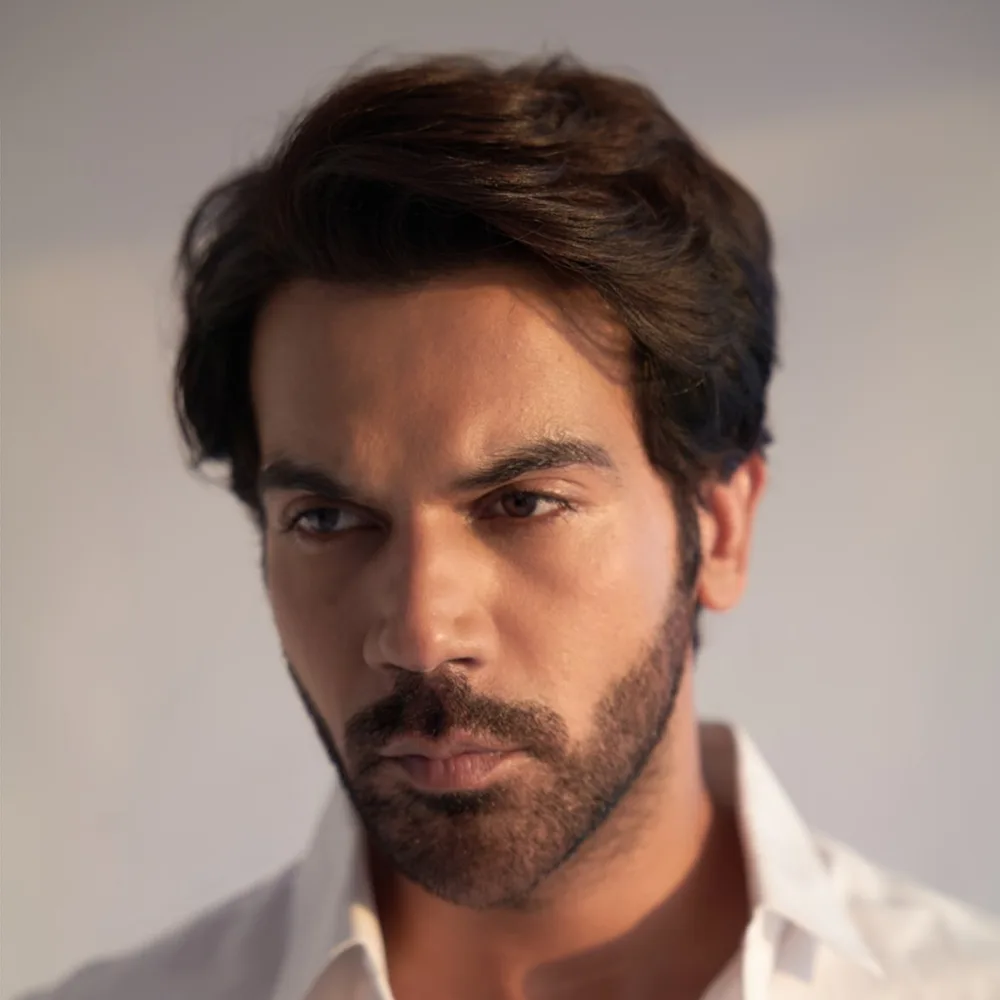
Biography & Career Overview
Rajkummar Rao was born Raj Kumar Yadav on 31 August 1984 in Prem Nagar, a neighbourhood of Gurgaon in Haryana, and both of those names stay in the public record. His is the least likely success story this archive keeps. The son of a clerk in the Haryana revenue department, he reached acting by way of school plays, college theatre in Delhi and one batch at the Film and Television Institute of India. He spent his first years in the industry in small parts, then in lead roles in films that critics defended and box offices often missed. The professional recognition arrived early and kept arriving: a National Film Award for Best Actor, five Filmfare Awards and an Asia Pacific Screen Award. The money came much later, and it came through horror comedy, with Stree (2018) and then Stree 2 (2024), the highest-grossing Hindi film of that year.
Two things put him in a Yadav archive. The first is the birth name. He carried Yadav through his first six films and switched his surname to Rao in 2014, so the trade press has written him both ways, and searches for "Raj Kumar Yadav" and "Rajkumar Yadav" reach him. The second is the type of career he built. He is an unusual case in 2010s Hindi cinema of an actor holding lead-parts status on performance credit alone, with no producing family, no studio launch, and none of the physical marketing that usually comes with that position.
Gurgaon, Delhi theatre, Pune
Rao was born to Satya Prakash Yadav, who worked in the Haryana revenue department, and Kamlesh Yadav, who kept the household. He had two older siblings and grew up among three cousins in Prem Nagar, then a middle-class colony in a town that was turning into an office city around him. He finished Class 12 at S.N. Sidheshwar Senior Secondary Public School in Gurgaon, where school plays were his first audience, and took a degree at Atma Ram Sanatan Dharma College under Delhi University. Delhi is where the hobby became a plan: he worked in theatre with the Kshitij group and with the Shri Ram Centre. He has said in interviews that watching Manoj Bajpayee is what convinced him the profession was reachable. He joined the acting course at the Film and Television Institute of India in Pune and passed out in 2008.
His mother died in 2016 and his father in 2019, both before the commercial turn. The birthday interview he gave to the Hindustan Times in 2017 is built around a gift from his mother, an army uniform, which he called the best present he had received.
2010 to 2012: three seconds, then found footage
After FTII he spent a year walking into studios and sitting in front of casting directors. Ram Gopal Varma's Rann (2010) gave him an uncredited three seconds as a newsreader. He found Love Sex Aur Dhokha in a newspaper advertisement saying Dibakar Banerjee was looking for newcomers for a found-footage anthology. Rao plays Adarsh, a supermarket supervisor who engineers a hidden-camera trap in the film's second segment. The film was noticed for its form and for its cast. Ekta Kapoor then offered him the lead of Ragini MMS (2011), another found-footage horror, and he took it although he did not want a second role so close to the first; the casting director Atul Mongia talked him into it. Bejoy Nambiar's Shaitan (2011) followed with Rao as a corrupt policeman, and Raja Sen, writing negatively about the film overall, called his work "reliably terrific".
Anurag Kashyap had seen Love Sex Aur Dhokha and cast him as Shamshad Alam in Gangs of Wasseypur – Part 2 (2012); Rao travelled to Wasseypur to get the accent. That year he also played the freedom fighter Lokenath Bal in Chittagong and a police officer in Reema Kagti's Talaash, which took more than ₹1.74 billion worldwide and finished as the eighth highest-grossing Hindi film of 2012. Two years in, he was still supporting in other people's films.
2013: Shahid and the year the industry noticed
The turn was Hansal Mehta's Shahid, released in October 2013. Rao plays Shahid Azmi, the Mumbai lawyer who defended people accused of terrorism and was shot dead in his own office in 2010. He met the Azmi family, read the Quran, and sat in courtrooms to learn how advocates carry themselves. He said afterwards that the role emptied him out. The reviews were close to unanimous and the awards came in a set: the National Film Award for Best Actor at the 61st National Film Awards, announced in April 2014, and the Filmfare Critics Award for Best Actor. Kai Po Che!, Abhishek Kapoor's adaptation of Chetan Bhagat's novel The 3 Mistakes of My Life, gave him the popular version of the same year, alongside Sushant Singh Rajput and Amit Sadh, and his first Filmfare nomination in the supporting category. Rao has credited the two films together with buying him access to the wider set of offers that followed.
The independent decade, 2014 to 2018
What came next was a run of small films that reviewers remember better than the trade tracks them. CityLights (2014), again with Mehta, cast his future wife Patralekha opposite him as a Rajasthan farm family that moves to Mumbai; he spent a month in Sadri in Pali district on the dialect and the moustache. In Queen (2014) he played the narrow fiancé whose behaviour ends the wedding plan, and the film crossed ₹970 million worldwide. Aligarh (2015) put him as an inquisitive journalist opposite Manoj Bajpayee's Professor Siras and brought a second Filmfare supporting nomination. Trapped (2016), Vikramaditya Motwane's survival story about a man with no water, food or electricity in a high-rise, cost him weight, a carrot-and-coffee diet through the shoot, and, at the director's insistence on realism, the first meat he had ever eaten, since he is otherwise a vegan. It won his second Critics Award.
2017 showed the range all at once. Bareilly Ki Barfi, a romantic comedy with Ayushmann Khurrana and Kriti Sanon, won him the Filmfare Award for Best Supporting Actor; Namrata Joshi wrote that the part "could have become a caricature in the hands of a lesser actor". Newton, Amit V. Masurkar's black comedy about an upright election clerk posted to a Naxal-affected town, premiered at the 67th Berlin International Film Festival and won him the Asia Pacific Screen Award for Best Performance by an Actor. He asked the director whether he could curl his hair and blink frequently to make the clerk more distinct, and Masurkar agreed. Bose: Dead/Alive, a historical mini-series for ALTBalaji, had him gain 13 kg and take his hairline back for Subhash Chandra Bose. Omerta, Mehta's film in which Rao plays the terrorist Ahmed Omar Saeed Sheikh, premiered at Toronto in 2017 and released in India the next year; he described it as the toughest character he had done and said the shooting left him disturbed.
The commercial break arrived at the end of that stretch with Stree (2018), Amar Kaushik's horror comedy built on the Bengaluru rumour Nale Ba, co-starring Shraddha Kapoor. It earned well, and it gave him his first Filmfare nomination for Best Actor.
2019 to 2023: streaming, losing streaks, one hero award
The following years were uneven in the ordinary way careers are. Ek Ladki Ko Dekha Toh Aisa Laga (2019) was widely praised for putting a closeted daughter at the centre of a mainstream Hindi release and did not recover its cost. Judgementall Hai Kya and Made in China came and went. The White Tiger (2021), Ramin Bahrani's adaptation of Aravind Adiga's novel for Netflix, was his English-language debut, with Priyanka Chopra and Adarsh Gourav; David Rooney in The Hollywood Reporter noted how he balanced a Western-educated habit of self-justification against the air of entitlement the character cannot drop. Ludo (2020) and Chhalaang (2020) went to streaming during the pandemic, and Anupama Chopra picked him out as one of the former's standouts. Shimla Mirchi, Roohi and Hum Do Hamare Do were received badly.
Badhaai Do (2022) is where the industry handed him the hero's prize. He and Bhumi Pednekar play a gay policeman and a lesbian teacher who enter a lavender marriage to get their parents off their backs; he went on a long diet and training regime for the physical look Harshavardhan Kulkarni wanted, and won the Filmfare Award for Best Actor. HIT: The First Case, Monica, O My Darling and Bheed (2023) kept returning him to police uniforms and strained men, which reviewers began to name as a habit. Guns & Gulaabs, Raj & DK's Netflix series set in a fictitious 1990s opium town, was the exception.
2024 onward: the numbers finally come
Four releases in 2024, and the biggest of his life. Srikanth made him the visually impaired industrialist Srikanth Bolla; he spent time at schools for the blind, worked from video of Bolla's own mannerisms, and took his third Filmfare Critics Award for Best Actor. Mr. & Mrs. Mahi and Vicky Vidya Ka Woh Wala Video lost money. Stree 2 did not: reprising Vicky, the film grossed more than ₹8.75 billion worldwide, the highest-grossing Hindi film of 2024 and the seventh highest-grossing Hindi film of all time. Rao said the run gave his confidence a lift it badly needed after the losing years. Bhool Chuk Maaf (2025), a wedding-day time-loop comedy delayed by the 2025 India–Pakistan conflict and by distributor problems, beat expectations. Maalik, an action film in which he plays a gangster, did not; he built muscle and grew out his hair and beard for it, and Rahul Desai in The Hollywood Reporter India wrote that Rao was a "shapeless actor" who managed to infuse details into the character that the writing had not supplied. He produced and starred in the Netflix comedy Toaster in 2026, and has Prahaar: The Untold Story of Ujjwal Nikam and a Sourav Ganguly biopic in front of him.
The criticism followed the success. Udita Jhunjhunwala, writing in Mint, said he had settled into playing "the small-town boy facing a harrowing situation", and Sukanya Verma at Rediff, dismissing Bhool Chuk Maaf, called him the "perennially exasperated small-town lad grappling with a rom-com crisis". Shreyas Pande in The Hindu made a similar argument about Toaster: the early films worked because he played familiar faces that other people ignored, and the mainstream shift cost him that advantage.
The name, and why it matters here
Rao changed his surname from Yadav to Rao in 2014 and added a second m to the first name. His own explanation is on record: "Rao or Yadav, I can use either of the surnames as both are family names. As far as the double 'm' in the first name is concerned, it's for my mother. She believes in numerology." The awards bodies had already written him as Raj Kumar, including in the 61st National Film Awards announcement, and the double-m spelling became standard in the trade afterwards. This matters for an archive organised around the surname because the birth name is what people actually type. "Raj Kumar Yadav" and "Rajkumar Yadav" lead here, and they also lead to unrelated politicians of the same name, including members of parliament and state legislatures. This profile is about the actor, and readers looking for a politician should search the constituency instead.
He was born into a Hindu family and has said the label does not exhaust him, that he also identifies with Sikhism, with Christianity and with Islam. He is a vegetarian and is formally trained in taekwondo. PETA India named him India's Hottest Vegetarian Celebrity in 2017. Forbes India carried him on its 30 Under 30 list in 2014 and on the Celebrity 100 in 2017, the same year GQ put him among 50 Most Influential Young Indians. He has been a brand ambassador for Actimaxx and Seventh Street and for the Food Safety and Standards Authority of India's eat-right movement, and during the pandemic he donated an undisclosed sum to the PM CARES Fund, the Maharashtra Chief Minister's Relief Fund and Zomato's Feeding India.
Personal life
Rao began dating the actress Patralekha in 2010. They married on 15 November 2021 in Chandigarh, two years after working together in CityLights. Their daughter was born on 15 November 2025, which is also the couple's fourth wedding anniversary, as reported by Mint and the Hindustan Times. The two of them keep the household out of publicity, and he has given interviews about his parents and about his own work, with the marriage left out of them.
The 2025 song and the 2026 reply
In October 2025 Rao appeared in Modi Hai Toh Mumkin Hai, a promotional single by the music duo Meet Bros that praised the prime minister. Varun Dhawan, Arshad Warsi and Vikrant Massey also featured in the video. The online response was hostile and personal, and DNA India reported users calling the actors "spineless" and posting that they would stop watching their films. Rao did not argue with it at the time. In July 2026, while the Jantar Mantar protests were on in Delhi, he voiced support for the protesters, and answering a comment that brought the song up again, he said that one song does not define who he is, what he stands for or what his ideologies are, and that outsiders cannot know the pressure he was under. He deleted the remark and it circulated anyway, which reopened the 2025 argument. This archive records the episode because it belongs to the public record of a public figure and because it is contested. The criticism and his explanation are claims by named sources; readers should weigh them as such.
How this profile was verified
Date of birth, the Prem Nagar birthplace, his father's post in the revenue department, the school and college, the FTII batch of 2008, the filmography, the 61st National Film Award result and the Filmfare outcomes were cross-checked against the English Wikipedia article on Rao, the Times of India and India Today reports of the 2014 National Film Awards, the Hindustan Times birthday interview of 31 August 2017, the Mint profile of 18 February 2013, IMDb's credit list, and the November 2025 birth coverage in Mint and the Hindustan Times. Some fan and social-media pages report an ancestral village at Ganaur in Sonipat district; no citable mainstream source confirms it, so this profile does not publish one, and the birthplace given here is the one the Hindustan Times and Mint reporting supports. Box-office figures are trade-reported worldwide grosses, not audited accounts. The 2025 song episode is carried as attributed reporting from the outlets named above. Corrections can be filed through the correction policy on this site.