
In short: For roughly a century and a half, from about 1187 to 1317 CE, a Deccan kingdom calling itself Yadava (the Seuna dynasty in inscriptions) ruled a realm stretching between the Narmada and Tungabhadra rivers from its fortress-capital Devagiri (today's Daulatabad, near Chhatrapati Sambhajinagar or Aurangabad). The dynasty matters twice over to Yadav history: it is the most prominent state to carry the Yadava name, and it fixed the standing of the Krishna-linked Yadava identity in the western Deccan centuries before that identity was adopted by communities at large. Its roots lie in the mid-9th century as feudatories of the Western Chalukyas; its independence, its golden age, and its dramatic conquest by the Delhi Sultanate are all part of mainstream Indian history. This article separates the datable record from the traditional genealogy, the way our origins of the Yadav community guide separates legend from inscription.
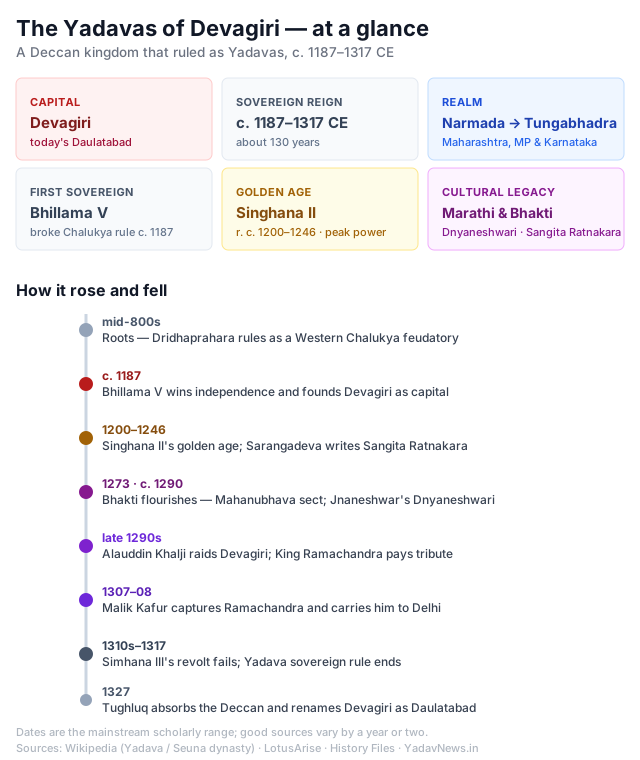
At a glance: the key facts and the rise-and-fall timeline of the Yadava (Seuna) kingdom of Devagiri.
What was the Yadava dynasty of Devagiri?
Direct answer: The Yadava (or Seuna) dynasty was a medieval Hindu ruling house of the western Deccan that ruled as a sovereign power from c. 1187 to 1317 CE, with its capital at Devagiri. At its height its territory covered much of present-day Maharashtra, extended into north Karnataka and parts of Madhya Pradesh, and reached from the Narmada in the north to the Tungabhadra in the south. The kings took the title Yadava and, through their court writers, traced their lineage to the legendary Yadu and the clan of Krishna, a claim of descent shared with the wider Yadav community but recorded here in the specific context of a ruling dynasty. The outline rests on Wikipedia's Seuna (Yadava) dynasty article, which is also where the name "Yadava dynasty" leads.
It is worth being precise about names. "Seuna" is the form that appears in the dynasty's own inscriptions and in modern scholarship; "Yadava" is the name the family and its poets claimed for themselves through their genealogy. The two refer to the same house, and this article uses them interchangeably.
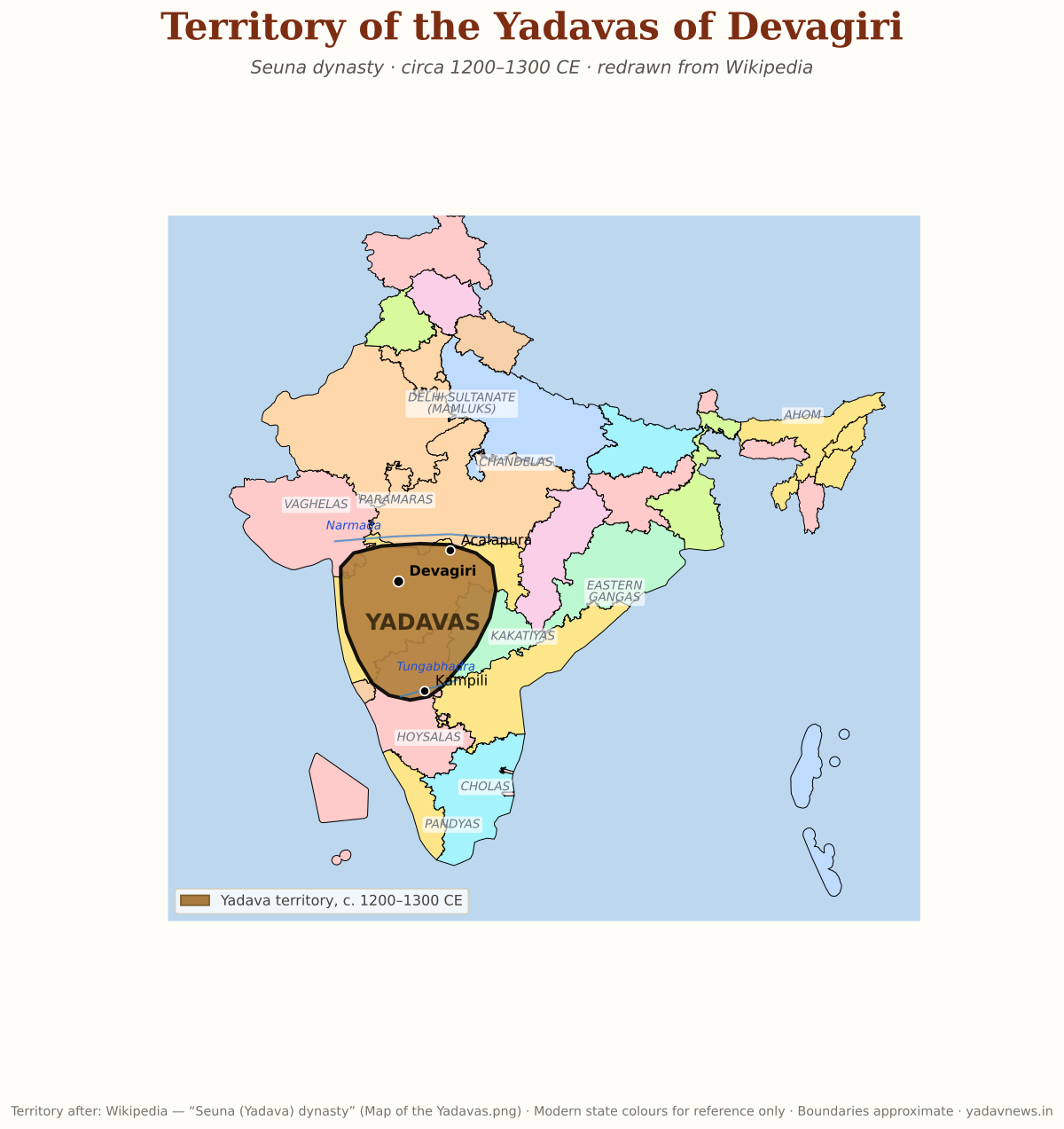
Figure: the Yadava (Seuna) kingdom set within the wider political map of India, c. 1200-1300 CE. The brown-shaded realm is Yadava territory at its height, bounded by the Narmada in the north and the Tungabhadra in the south, with the capital Devagiri and the towns of Acalapura and Kampili marked; the surrounding kingdoms are shown for context. Redrawn from Wikipedia - boundaries are approximate and modern state colours are used only as a reference.
How did the Yadavas come to power?
The dynasty did not begin as kings. Its earliest historically attested chief, Dridhaprahara (mid-to-late 9th century CE), is credited in the court chronicle tradition with founding a town and ruling as a feudatory of the Western Chalukyas of Kalyani. For generations the Seuna family served the Chalukyas as local governors and warriors, not as a sovereign house.
Independence came as Chalukya power collapsed in the second half of the 12th century. Bhillama V (r. c. 1173-1191 CE) is regarded as the first sovereign Yadava king. Around 1187 he broke free of his Chalukya overlords, fought the Hoysala king Ballala II for control of the former Chalukya heartland in present-day Karnataka, and after taking the old Chalukya capital Kalyani founded Devagiri as his own capital, a natural hill fortress that gave the kingdom its name. A Mutugi inscription of c. 1189-90 styles him a universal ruler ("Chakravartin") of the Yadava line. The date 1187, when Bhillama asserted sovereignty, is the conventional start of the independent dynasty.
Who was the greatest Yadava king?
Singhana II (also written Simhana, r. c. 1200-1246 CE) is the dynasty's defining ruler; under him the kingdom reached its territorial and cultural peak. Born at Sinnar, he was crowned his father's heir around 1200 and later marked his victories with a second coronation. His armies fought and for long periods dominated the neighbouring Hoysalas, Kakatiyas and Paramaras, and checked the waning Chalukyas; no rival Deccan power could safely challenge him while he ruled.
Singhana's court was also a centre of learning. The musicologist Sarangadeva, author of the Sangita Ratnakara (still one of the foundational treatises of Indian classical music), is associated with his reign, and scholars of astronomy and mathematics flourished under Yadava patronage. This combination of military strength and high culture is why the Yadava period is remembered as a golden age of the western Deccan.
What was Yadava administration and society like?
Yadava government followed the broad pattern of contemporary Deccan kingdoms: a hereditary monarchy supported by a trained bureaucracy, a council of ministers, and military commanders (nayakas) who governed provinces, often alongside feudatories who held local authority in exchange for service. Officers handled the treasury, seals, and the hill forts that made the kingdom defensible; at the village level, local assemblies and craft guilds managed everyday affairs and disputes by custom.
Society was organised by caste and occupation, and the period is notable for the rising social status of pastoral and farming communities of the kind from which the wider Yadav identity would later be drawn. The Yadava rulers were, on the whole, religiously tolerant: Jainism and Shaivism retained support, and new devotional movements found room to grow, a climate that directly shaped the culture described next.
Why is the Yadava court remembered for Marathi and the Bhakti movement?
This is the Yadavas' most lasting contribution. The dynasty's era saw Marathi emerge as the dominant language of royal inscriptions, displacing the Kannada and Sanskrit used earlier, a decisive step in the history of Marathi as a literary and administrative language. The period produced some of the founding works of the language: Mukundaraja's Vivekasindhu, an early Marathi philosophical text, and above all the work of the saint-poet Jnaneshwar (Dnyaneshwar), whose Dnyaneshwari (a Marathi commentary on the Bhagavad Gita composed around 1290) is still recited daily across Maharashtra.
The Yadava kingdom was the stage for the great devotional currents of the Deccan: the Mahanubhava sect associated with Chakradhara (from 1273), and the growing Vitthal (Vithoba) bhakti at Pandharpur that would become the living heart of Maharashtra's religious culture. Court figures like the minister-scholar Hemadri, whose Chaturvarga Chintamani is a vast encyclopaedia of ritual and whose writings also preserve the dynasty's own genealogy, tie Yadava statecraft directly to the Yadava claim of descent from Krishna's line. Physical monuments of the age include the Gondeshwar temple at Sinnar and Devagiri fort itself.
How did the Yadava dynasty end?
The end came from the north. The Delhi Sultanate under Alauddin Khalji had already struck the Deccan in the late 1290s, extracting tribute from the Yadava king Ramachandra (r. c. 1291-1309) after his first raid on Devagiri. In 1307-08 CE, Alauddin sent his general Malik Kafur against Devagiri again; Kafur's army overwhelmed the Yadavas, took Ramachandra prisoner and carried him to Delhi, where the Sultan treated him with respect and re-instated him as a vassal.
Yadava independence did not survive that humiliation. Ramachandra's son Simhana III (Shankaradeva) attempted a revolt against Delhi; he was defeated and killed, and the dynasty was extinguished by the early 1310s. Deccan was formally absorbed into the Delhi Sultanate's expanding southern reach, and Devagiri (renamed Daulatabad a century later when the Sultan Muhammad bin Tughluq moved his capital there in 1327) entered the imperial map of north India. This is the "annexed by the Delhi Sultanate in the 1310s after Malik Kafur's raids" endpoint summarised in our origins guide.
Why does the dynasty matter to Yadav identity today?
The Yadava kingdom is the clearest historical proof that the idea of a Krishna-descended "Yadava" people carried sovereign prestige a full seven centuries before the modern community name was consolidated. That is exactly why community origin-organisations, from the early-1900s All India Yadav Mahasabha onward, reached for the Devagiri Yadavas as an ancestral crown. The honest position (the one YadavNews keeps) is that the dynasty shows what the Yadava name was worth and how deep the Krishna-linked tradition runs, while the genealogical link between a medieval Deccan ruling house and today's widely distributed Yadav, Ahir, Golla and Idaiyar communities remains aspiration and identity, not documented descent. The same care that separates the dynasty's history from a bloodline claim also applies to the older legendary layer; both are handled in the origins guide, which places Devagiri within the fuller story from Yadu and Krishna to the 1931 census.
A note on the dates
Medieval Indian chronology is not a single set of agreed numbers, and the Yadava dates shown across good sources vary by a year or two at the key turning points: the raids on Ramachandra are variously dated to the mid-1290s and to 1307-08, and the dynasty's close to somewhere between 1310 and 1317. This article follows the mainstream range (independence c. 1187, annexation by the early 1310s) and states the spread openly, since the records supply no more precision than that. Where a claim depends on the dynasty's own court writers (especially the genealogy that links the Seuna house to Krishna) we present it as the Yadavas presented it: a claimed lineage, historically important as an idea. You can read how YadavNews weighs and corrects such sources in our editorial policy, and the Hindi edition of this article is published for parity in the इतिहास section.