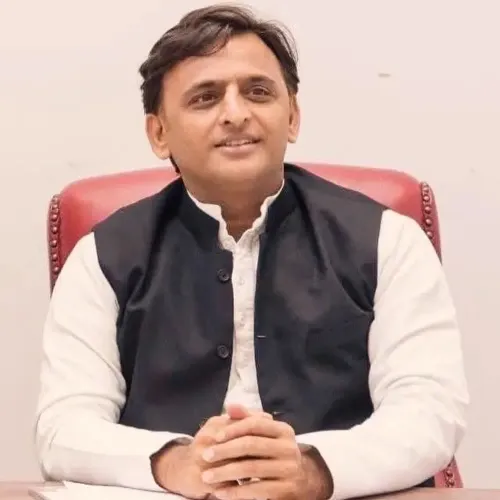
Biography & Career Overview
Tej Pratap Singh Yadav has been returned to the legislature twice, both times in a by-election, both times in a seat somebody else in his family vacated. The first was Mainpuri, a Lok Sabha seat, on 16 September 2014, when he was twenty-six years old and the vacancy had been created by Mulayam Singh Yadav winning Mainpuri and Azamgarh together and deciding to keep Azamgarh. The second was Karhal, an assembly seat in the same district, on 23 November 2024, and that vacancy had been created by Akhilesh Yadav winning Karhal in 2022 and Kannauj in 2024 and deciding to keep Kannauj. In between he sat one full term in the lower house, did not contest the 2019 general election from it, and was named by his party as its Kannauj candidate in April 2024 for two days before the party chief chose to stand there himself.
He holds no ministerial office in either capacity that this desk could establish, and he has never been reported as an accused in a criminal case. His own sworn election papers in both 2014 and in 2024 record no criminal case at all. That last sentence needs a qualifier, and the qualifier is the reason this page exists as a separate profile. There is a second politician in Indian public life with the same first two names, Tej Pratap Yadav, the elder son of Lalu Prasad Yadav and the brother-in-law of this man. The second Tej Pratap has been arrested, has fought bail applications and fills the search results for the name. The two men are relatives by marriage and they are not the same person, and a great deal of what a reader will find on this name in a search engine belongs to the other one.
The documentary record for this man is unusually clean for a profile of this kind. Two candidate declarations filed with the Election Commission of India and transcribed by the Association for Democratic Reforms give his age, his education, his money and his liabilities on two dates ten years apart, and the two documents disagree with each other on his qualifications. A parliamentary data service gives his attendance, his questions, his debates and the two bills he introduced as a private member. Four newspapers report the two by-elections, the Kannauj episode and the wedding. This page is built out of those, it says plainly where a fact rests on a single report, and it leaves the contradictions standing.
What this page is made of
The primary documents are his own. The first is the declaration filed for the Mainpuri by-election, polled on 13 September 2014. The second is the declaration filed for the Karhal by-election, polled on 20 November 2024. Both were read through the MyNeta archive of the Association for Democratic Reforms, which transcribes the papers candidates file with the Election Commission and states that it neither adds to nor subtracts from them. The expenditure returns for 2014, and the absence of a total in the 2024 return, come from the same archive. The parliamentary numbers are from PRS India's member tracker for the 16th Lok Sabha.
The secondary record is newspaper reporting, and this page names the paper at each point where a claim rests on it: the Times of India, the Indian Express, the Hindu, Hindustan Times and the Economic Times, along with NDTV, ThePrint, Mid-Day, India Today, plus the New Indian Express, together with the English Wikipedia article on him for the birth date, the village and the family names it cites. Where a newspaper and a sworn document give different answers, both appear here and the document leads. Where a newspaper reports something no document confirms, it is written as reported and not as established.
One further thing this page does not do. It carries no telephone number, no residential address and no email. It carries no profile of his wife, his son or any other relative, and the child is recorded as a count with a date and not by name. The dependents listed in his declaration are treated as entries in a return.
Two men called Tej Pratap
The Samajwadi Party's man from Mainpuri and the Rashtriya Janata Dal's man from Patna share a given name, a surname, a Yadav politics world and, since 2015, an in-law relationship: the subject of this profile married Raj Lakshmi Yadav, the youngest daughter of Lalu Prasad Yadav, who is the father of the other Tej Pratap Yadav.
The confusion is not a readership failure. The Times of India's own report of the Karhal result calls this man "Tej Pratap Yadav of the Samajwadi Party" and then, four paragraphs later, describes him as the "nephew of Akhilesh Yadav and son-in-law of RJD supremo Lalu Prasad Yadav". The wire and portal reporting on the Bihar side uses Tej Pratap Yadav unqualified and means the RJD leader. A reader who arrives here from a search for either man should check the party and the state on every document.
The consequences for a biography are practical. Every arrest, every bail order, every first information report and every land-for-jobs allegation that a search returns under these names belongs, in the material read by this desk, to the RJD leader and to no one else. The man profiled here declared no criminal case in 2014 and none in 2024, and this desk found no charge sheet, no conviction and no reported arrest against him. That is a statement about the absence of a record and not a finding about conduct.
Saifai, Etawah and the family he was born into
The English Wikipedia article on him gives his birth as 21 November 1987 in Saifai, a village of Etawah district, to Ranvir Singh Yadav and Mridula Yadav. Saifai is known in election reporting for the government medical college that carries the family name, and the article places it in the Yadav family lineage of Uttar Pradesh politics.
His own papers give the father in the standard form. The 2014 declaration and the 2024 declaration both enter him as the son of Ranveer Singh. That is the only biographical fact in his profile that the two documents agree on without qualification, along with the village.
The 2014 declaration enrols him as a voter in the Jaswant Nagar assembly constituency of Etawah, at serial 218 in part 199. Jaswant Nagar is a block and a seat some distance from Saifai inside the same district. The 2024 declaration enrols him in the Mainpuri parliamentary constituency, at serial 586 in part 220, which is the roll that Karhal sits inside. So between the two elections he moved his name from a roll in Etawah to a roll in Mainpuri, and the second move took his entry to the district where the assembly seat he now holds actually is.
His place in the family is where the record starts to slide. The Wikipedia article states that his grandfather Ratan Singh Yadav was the younger brother of Mulayam Singh Yadav. The Indian Express, reporting the day after the 2014 result, called him the grandson of Mulayam Singh Yadav's elder brother, the late Ratan Singh Yadav. The same paper's 2024 report on the Kannauj episode called him the maternal grandson of Ratan Singh Yadav. A patrilineal grandson and a maternal grandson are different genealogies, and elder and younger are opposite answers about the same two brothers. The article's version and the paper's version are both printed here because this desk found no document that settles the order of births.
The same article adds one relation the declarations do not: Hariom Yadav, a former member of the Uttar Pradesh legislature from Sirsaganj and later from Shikohabad, as his maternal granduncle. The Indian Express counted him, on the night of the 2014 result, as the thirteenth member of the extended family to enter active politics and the seventh from it to sit in the Lok Sabha.
He is therefore the first cousin of Akhilesh Yadav's son in the reading this page finds most likely, which is how he came to be called Akhilesh Yadav's nephew in reporting, and the press uses that word loosely in both directions. The exact degree is a family matter and the papers carry only the labels. What the documents do establish is the arithmetic of the two elections below.
The schools and the two different answers about them
The Wikipedia article puts him at Colonel Brown Cambridge School in Dehradun and then at a Delhi Public School in Noida. Those two lines sit comfortably with the school years in his 2014 declaration, which records a Central Board of Secondary Education class twelve result in 2005 and a class ten result in 2003, both from Delhi. He would have been fifteen at the class ten entry and seventeen at the class twelve one.
After school the two declarations part company. The 2014 paper puts his category as Post Graduate and then runs four lines: M.B.A from Leeds University in the United Kingdom in 2009, B.Com from Amity University in Noida in 2008, class twelve in 2005, class ten in 2003. The article names the Leeds University Business School as his alma mater and files him in its alumni category. Reporters used the same facts on the 2014 campaign trail, and the Indian Express described a masters degree from Leeds in the United Kingdom as the distinction that set him apart within the family.
The 2024 paper puts his category as Graduate and prints one line: B.Com from Amity University, Noida, in 2008. The management degree is gone. MyNeta tabulates his education level for the Karhal contest as Graduate and, in the comparison chart of the party candidates in that by-election, records him as the only Graduate among the four principal names, with the Bharatiya Janata Party candidate, the Bahujan Samaj Party candidate and an independent all entered as Post Graduate.
A candidate who declared a master's degree in 2014 and a bachelor's degree in 2024 has either corrected an overstatement or made an error somewhere, and this desk has no document that says which. The honest reading is the plain one: the MBA appears in his earlier paper and in the article and in two newspapers' reporting of the 2014 campaign, and it does not appear in his later paper. Both papers are his own sworn statements and they are quoted as such throughout this profile.
2014: a by-election at twenty-six
The Mainpuri seat fell vacant because of a success and not a death or a resignation in the ordinary sense. Mulayam Singh Yadav, then the union defence minister and the party president, contested the 2014 general election from Azamgarh as well as from Mainpuri, won both, and kept Azamgarh. The Economic Times, carrying a PTI report on the day the result of the by-election came through, wrote that the poll had been necessitated by the resignation of Mulayam Singh Yadav, who had also won Azamgarh. The Times of India put the same sequence in the paper's own words on the eve of polling: he had contested from Azamgarh and Mainpuri, won both, later relinquished the Mainpuri seat, and that produced the by-election.
The Samajwadi Party fielded Tej Pratap Singh Yadav against the Bharatiya Janata Party candidate Prem Singh Shakya. Polling took place on Saturday 13 September 2014 and the result came on Tuesday 16 September. The figures in the Wikipedia table for the constituency give Yadav 6,53,786 votes, which is 64.46 per cent of what was polled, against 3,32,537 for Shakya at 32.79 per cent, a difference of 3,21,249 votes on a total of 10,14,232. The Indian Express, on the day of the result, wrote that he had defeated the BJP candidate by a huge margin of 3.21 lakh votes, which is the same margin to the thousand.
The paper also recorded his age as twenty-six on the night, which matches the affidavit entry of 26 for a man born on 21 November 1987, since his birthday fell two months after polling. The Times of India, in a report filed two days before polling, called him 27 years old. Both figures are in the same week's reporting and the affidavit is the one that ties to the stated birth date.
What he said about the seat he had just taken was reported by the Times of India on the campaign trail: that his entry into politics had nothing to do with dynasty and that he had been selected because people demanded it. The Indian Express, on the result day, went the other way with the same material and framed the contest as the fifth of the family joining the party chief in the Lok Sabha. He was one of the youngest members of that house. In October 2016 the Economic Times introduced an interview with him in exactly those words, the 28-year-old nephew of Akhilesh Yadav and one of the youngest MPs from Mainpuri.
What the 2014 declaration says
The paper he filed for that contest gives total assets of 4,29,05,696 rupees and liabilities of 10,80,561 rupees, and both figures sit at the scale one would expect of a first-time candidate living on a small inherited landholding. The movable column totals 56,85,496 rupees. Inside it: cash of 4,80,375 rupees, a series of fixed deposits with Punjab National Bank in Saifai, two with the Uttar Pradesh Sahakari Gramin Vikas Bank at Saifai, one vehicle, a 2012 Fortuner with the registration number UP75R9999, valued at 13,00,000 rupees, and nothing at all under jewellery or under other assets and interests.
The rest of the balance sheet is inherited farmland around Saifai and Larkhour in Etawah, entered with fractional shares against survey numbers and valued at market rates: a 0.627 hectare plot at 18,80,400 rupees held to the extent of one quarter, a 0.688 hectare plot at 41,28,000 rupees held to the extent of one half, a 1.081 hectare plot at 43,24,000 rupees to one third, and a plot at Larkhour held to one tenth. Every one of those entries is entered as inherited, with no purchase date and no purchase cost. He declared the profession as agriculture work and director in company, and left the spouse profession line empty. He was unmarried at the time.
His income and tax table gives a PAN for himself and one return, with a total income of 15,22,423 rupees for the year 2013 to 2014. The columns for spouse, Hindu undivided family and dependents are entered with no PAN and no return. The criminal case section is empty and the archive's readability report on it records no problems.
Two features of this document matter for what happened later. The first is that the only vehicle in it is registered in Uttar Pradesh, and there is no property anywhere outside Etawah district. The second is that the whole declared estate, a fraction of the size of the one he would file ten years later, sits in land he did not buy.
Five years in the lower house
PRS India tracks him for the 16th Lok Sabha with a start of term on 16 September 2014 and an end on 20 May 2019. The Wikipedia infobox runs the same term from 13 September 2014 to 23 May 2019, and the two dates at either end are four and seven days apart respectively, which is the difference between polling day and the day the result was declared, and between the end of sittings and a formal dissolution. Both pairs are printed here.
Against the house averages PRS gives him, the numbers are those of a member who was present and quiet. His attendance was 86 per cent, which is above the national average of 80 for that house and level with the average for members from Uttar Pradesh. He took part in 22 debates, where the national average was 61.9. He asked 257 questions, against a national average of 275, so he is close to par on questions and about a third of par on speaking. He introduced two Private Member's Bills: the Constitution (Amendment) Bill of 2018 and the Fake News (Prohibition) Bill of 2019. A private member's bill in the Indian parliament is drawn by ballot, is almost never taken up, and its introduction is a statement of intent and nothing more. Both are listed here because the tracker lists them and because the second one is the closest thing in his record to a policy position of his own.
PRS also records the subjects he raised. Under the rules that allow a member to put a matter on record without a debate, he spoke on 5 February 2019 about restoring the old pension scheme, and on 12 February 2019 about Akhilesh Yadav being prevented from taking part in a function at Allahabad University, which is the clearest instance in the official record of him defending his cousin in the house. The rest of the entries are constituency notices asking for things: a mega food park, a passport seva kendra, a central government health scheme centre, a Kendriya Vidyalaya and a Sainik School for Mainpuri.
PRS lists no parliamentary departmental committee for him across the five years, and the official member biography page at sansad.in returns a script-rendered application that gave this desk no data at all. So this page cannot report committee work, cannot report a ministerial appointment, and records the absence of both as an absence of evidence, which this page declines to convert into a judgement about his diligence.
In the two and a half years between his election and the end of the term, the public statements attributed to him are few and mostly about the party. The Economic Times published an interview on 9 October 2016 in which he said Akhilesh Yadav could become the prime minister of India, expressed confidence that the Samajwadi Party would win the 2017 Uttar Pradesh assembly election, and answered a question about the party's internal hierarchy with the line that it is Netaji who is supreme in the Samajwadi Party and that whatever he says is sacrosanct. Netaji is the honorific the party uses for Akhilesh Yadav. He made the statement at a point when the party was publicly debating whether the old guard or the younger generation held it.
2019: the seat goes back, and he stands aside
He did not defend Mainpuri at the 2019 general election, and this desk found no report of a ticket having been offered to him that year. The seat went back to Mulayam Singh Yadav, the same man who had given it up in his favour five years earlier. The Wikipedia table for the constituency gives the 2019 result as Mulayam Singh Yadav winning with 5,24,926 votes against 4,30,537 for Prem Shakya of the Bharatiya Janata Party, a margin of 94,389 votes on those two figures and a considerably tighter seat than the one the twenty-six-year-old had taken in 2014.
Mulayam Singh Yadav died on 10 October 2022 and the Mainpuri seat passed to Dimple Yadav, the wife of Akhilesh Yadav, at the 2024 general election. Tej Pratap Singh Yadav had by then already been chosen, and unchosen, for another constituency.
The Kannauj question in April 2024
The Samajwadi Party announced him as its candidate for Kannauj for the 2024 general election. Hindustan Times reported on 23 April 2024 that the party had named the party chief's nephew at Kannauj in order to end the speculation about whether Akhilesh Yadav would contest from there, and described Tej Pratap Singh Yadav as 36 years old, making his debut in the Lok Sabha from Mainpuri in 2014. NDTV's report on the announcement is dated 22 April 2024.
Two days later the party reversed. The Indian Express reported on 24 April 2024 that just two days after declaring Tej Pratap Singh Yadav's candidature from Kannauj, the Samajwadi Party said on the Wednesday that party chief Akhilesh Yadav would instead contest from there. The same article gives him as the grandson of Ratan Singh Yadav, with the paper's elder brother and maternal grandson wording recorded above, and as the son-in-law of Lalu Prasad Yadav.
He therefore did not stand at Kannauj and never contested a general election to the Lok Sabha. Akhilesh Yadav stood there and won it, as ThePrint reported on 4 June 2024, and India Today the following day. What the two papers report about the reversal is that the announcement was made and then withdrawn, and neither account records a reason from him. The reader should note the shape of the episode: the party named him, the party un-named him within forty-eight hours, and the seat went to the man the party had originally been speculated about. There is no document in the record read here in which he is the one who steps down.
Kannauj is not the only seat his name was moved around in that election year, and this desk found no reliable account of any other. The by-election that gave him his seat came out of the same decision that made him available.
2024: the Karhal by-election
Akhilesh Yadav had held Karhal, assembly constituency 110 in Mainpuri district, since 2012, and won it again at the February 2022 assembly election. IndiaVotes records that contest as an electorate of 3,73,595 with 2,44,589 polled, which is a turnout of 65.47 per cent, Akhilesh Yadav returned with 1,48,196 votes, a share of 60.59 per cent, and a winning margin of 67,504 votes over the bahujan samaj party's rival. NOTA took 1,909 votes.
He then contested and won Kannauj at the 2024 general election, and a member of a state legislature cannot hold both seats. NDTV reported on 12 June 2024 that Akhilesh Yadav resigned from the Karhal assembly seat after winning the Kannauj Lok Sabha election, and The Hindu carried the same account on the same day. That resignation produced the by-election, held on Wednesday 20 November 2024, in which the Samajwadi Party fielded Tej Pratap Singh Yadav.
The result came on a Saturday, which is 23 November, as the Times of India's report states, and the paper gives his total as 104,304 votes against 89,579 for the Bharatiya Janata Party candidate Anujesh Pratap Singh, a winning difference of 14,725. The Bahujan Samaj Party candidate, Avanish Kumar Shakya, took 8,409 votes and lost his deposit, and the Azad Samaj Party candidate took 2,499. The paper wrote that the constituency recorded 54.1 per cent voting, that the counting ran over 32 rounds, that the Samajwadi Party led from the first of them, and that the win kept the seat with the party for a fifth consecutive time.
Put against the 2022 figures above, the same seat delivered 43,892 fewer votes to the party's candidate, a majority three quarters smaller, and a turnout eleven points lower. This is arithmetic on two published results and it is the sharpest single fact in the Karhal record: he took the seat, on a much reduced mandate, in a contest the party had lost nothing in.
MyNeta's candidate list for the by-election carries seven names, including two independents and a candidate of the Sarvjan Sukhay Party, Vivek Yadav, whose own declaration is the largest in the field apart from the winner's at 95 lakh rupees. The Times of India describes the count as a five-candidate election. The two numbers differ because the total polled in the paper's figures, 104,304 plus 89,579 plus 8,409 plus 2,499, comes to 2,04,791, and no consulted document in this desk's hands gives the full table of the by-election. The conflict is printed and unresolved.
The contest was reported as a family matter because the BJP's candidate came from the Saifai household. The Times of India wrote that the electoral battle was essentially between relatives, that Anujesh Yadav was Akhilesh Yadav's brother-in-law and that he belongs to the Saifai family. The two declarations answer only part of that. The BJP candidate's paper gives him as 45 years old, a postgraduate, with one criminal case against him covering five counts including voluntarily causing hurt to deter a public servant and assault or criminal force to deter a public servant, with total assets of 4,52,45,709 rupees and liabilities of 10,00,000 rupees, and as the son of Mithalesh Pratap Singh. Our subject's paper gives him as the son of Ranveer Singh. Two different fathers is the whole of what the sworn record says about the relationship, and the words uncle and brother-in-law in the paper are the paper's.
He spoke to reporters after the win, and the Times of India quoted three things. He accused the ruling party of suppressing voters, in the words "During the by-election, people were prevented from voting." He dismissed the significance of the rival's family standing by saying that the BJP was in front no matter who the candidate was. And he framed the result as the answer to the BJP's claim that it would avenge Ayodhya at Karhal, saying that the people here had given a fitting response. Dimple Yadav, the member of parliament for Mainpuri, was at the counting centre and told journalists that the BJP had failed to achieve its objectives in Karhal and in Kanpur, that this had not been possible despite the deployment of the entire official machinery, and that the party's administrative approach had been unethical.
The Samajwadi Party's own list of its members of the Uttar Pradesh legislative assembly carries his name against Karhal, constituency 110, which is the party's confirmation that he sits for it. This desk found no ministerial appointment, no deputy speakership, no committee roster and no party office for him after November 2024.
What the 2024 declaration says
The Karhal paper is a different document from the Mainpuri one in size. It gives total assets of 12,67,72,000 rupees against total liabilities of 2,29,05,000 rupees, both figures taken from the archive's transcription, and the arithmetic inside it holds: the movable column prints 6,22,87,000 and the immovable column prints 6,44,85,000, which add to the declared total exactly. Ten years earlier he had declared 4,29,05,696 rupees in assets, so the declared estate is a little under three times what it was, and the declared liabilities went from a little over ten lakh rupees to a little under two and a half crore.
The agricultural land is still inherited and still Etawah. Five parcels now appear, all marked inherited with no purchase date and no purchase cost: Saifai and tehsil Saifai at 41,28,000 rupees, Larkhor in Jaswantnagar tehsil at 54,46,000, Muchehra in Saifai tehsil at 1,44,26,000, Nayakpur in Saifai tehsil at 54,13,000 and Amarsurpur in Saifai tehsil at 20,22,000, which is a total of 3,14,35,000 rupees and matches the printed sub-total to the rupee. He has kept the fractional shares: 0.688 hectare at Saifai is the same plot that appears in the 2014 paper at the same valuation.
What is new was bought, and it lies outside the village. A non-agricultural plot of 1,225 square feet at Shivnarayan in Etawah district, entered with a purchase date in 2022, a purchase cost of 32,00,000 rupees and a market value of 40,00,000. An apartment at the old family address, Talab Road in Saifai, described as an old house, 3,000 square feet with 2,000 built up, held to one quarter and marked inherited, at 50,50,000 rupees. And one-third share of a property numbered A-PH 1 on the eighth and ninth floors of the Pearl Gateway Tower in sector 44 of Noida, bought in January 2020 for a recorded 1,00,00,000 rupees and valued at 1,20,00,000, which he enters once in his own column and again in his spouse's column, giving the household two crore and forty lakh in that single flat.
The movable side carries a poly house at Saifai valued at 30,00,000 rupees, interests in two agricultural limited liability partnerships, 1,55,00,000 rupees in one line of investments, cash of 5,00,000 rupees for himself and 2,00,000 for his spouse, and a long bank schedule running through the Saifai and Mainpuri and Etawah branches of the Punjab National Bank, the Bank of Baroda, the Bank of India, the Punjab and Sindh Bank, the Uttar Pradesh Gramin Vikas Bank, the HDFC Bank and the State Bank of India. Inside it sits one deposit of 42,99,000 rupees at the State Bank of India's Parliament House branch at Sansad Bhawan in Delhi, which is the branch an MP at that address banks at, and one joint account at the State Bank of India at 1,05,000 rupees. His profession on the 2024 paper is agriculture and business; his spouse's is a job.
The liabilities are where the document repays close reading. Under bank loans he enters 5,99,000 rupees at the Punjab National Bank branch at Saifai and a vehicle loan of 23,06,000 rupees at the Bank of India branch at Saifai. Under loans due to an individual or an entity he enters 75,00,000 rupees described as the purchase consideration, unpaid, of the same Noida apartment, and in the bank column the identical PAYBLE purchase-consideration entry of 75,00,000 rupees appears in the spouse column instead. Under other liabilities he enters a personal loan of 50,00,000 rupees. Add the self entries and you get 1,54,05,000 rupees, add the spouse entry and you get 75,00,000, and the grand total prints 2,29,05,000, which is exact. The reader should notice that the same unpaid instalment for the same flat appears twice in that arithmetic, once against him and once against her. If it is one debt entered on two lines, the household's real burden is 75 lakh lower than the declared total. This page prints the declared figure and flags the duplication.
The income and tax table gives him a PAN and five years of returns, with total income running 20,98,600 rupees for 2018 to 2019, 22,08,660 for 2019 to 2020, 11,97,070 for 2020 to 2021, 21,78,730 for 2021 to 2022 and 12,14,870 rupees for the year 2022 to 2023. His spouse's five returns run between 4,58,560 and 5,72,320 rupees. Two dependents are listed, without PAN and with no return filed and no income shown for either, and each carries 3,00,000 rupees in the movable cash line. The press record for the household reports one son, born in September 2016, so the count of dependents in a form is not a count of children and this page does not treat it as one. His declared income for the most recent year in the paper, 12,14,870 rupees, is lower than the single return he filed in 2014, which was 15,22,423 rupees, on an estate three times larger. The criminal case section is empty again, and the archive's readability report notes no problems in reading it.
The money of the two campaigns
The 2014 election expenditure return in the same archive is complete and itemised, and its grand total is 46,35,684 rupees. Of that, 45,67,934 rupees sits in the candidate's own column and 67,750 rupees in the party's. The largest single line by a wide distance is vehicles and the fuel spent on them, at 28,41,356 rupees, which is rather more than three fifths of the whole reported outlay. Campaign material comes next at 4,94,760 rupees, a line the form reserves for handbills, posters, cassettes, loudspeakers, plus the rest of the printed campaign, then rallies with star campaigners at 4,47,863, public meetings and processions without star campaigners at 2,95,965, campaign workers at 2,53,445 and campaign work through electronic and print media including cable at 1,59,670. Erections of gates, arches, cutouts, banners, plus anything of that shape are entered Nil, leader visits to the constituency are entered Nil, and the virtual campaign schedule is entered Nil.
The lines this desk could read add up to 44,93,059 rupees against the candidate column's calculated total of 45,67,934, a difference of 74,875 rupees that the copy in the archive does not itemise. The abstract of sources is more striking than the spending. Under it the amount of his own funds used for the campaign is Nil, the lump sum received from the party is 67,750 rupees, and the amount received from any person, company, firm, association or body of persons, as loan, gift or donation, is 45,18,434 rupees. Ninety-seven and a half per cent of what he declared spending came from third parties, and none of it from the account he had declared in the affidavit he filed in the same election.
No expenditure return with a total appears against the 2024 Karhal by-election in the same archive. The page prints a grand total line for the candidate, for the party and for other agencies and every one of them is empty, along with the remarks and the comment fields, and the data quality note on expenses is blank where the 2014 page carries an ok. That is a gap in the copy this desk read, and this page treats it as a gap. It does not treat a blank cell as a nil return, and it does not draw an inference from it about how much the second campaign cost.
The marriage that joins the two Yadav houses
He married Raj Lakshmi Yadav, the youngest daughter of Lalu Prasad Yadav and Rabri Devi, in February 2015. The Hindu, filing from the reception, put the ceremony inside the convention hall of the Ashoka hotel in New Delhi on a Thursday evening, which is 26 February 2015, and recorded that the prime minister Narendra Modi had flown to Saifai five days earlier, on 21 February, to attend the tilak ceremony. The paper wrote that among the first guests to arrive at the reception were the Bharatiya Janata Party patriarch L.K. Advani and the president of the Indian National Congress, Sonia Gandhi. India Today's photo report from the same event lists Sonia Gandhi, Jaya Bachchan, Priyanka Gandhi and Robert Vadra among the guests and notes the bride's dress as a Tarun Tahiliani creation.
The political meaning was written before the wedding and not after it. The Times of India, with a report by Subodh Ghildiyal filed on 28 November 2014, ran the match under the headline that a marriage may forge a new Mulayam-Lalu alliance, described the Samajwadi Party chief's grand-nephew as about to tie the knot with the Rashtriya Janata Dal supremo's youngest daughter, and wrote that the coming together of the two Yadav chieftains in kinship would erase bitter memories of how they had sparred during the 1990s. The paper's phrase for it was the merger before the merger. Whether that reading was right is a matter for the record of the following decade, in which the two parties were in opposition together in some years and at odds in others; this page records the claim as a correspondent's interpretation.
A son was born to the couple on 7 September 2016. Mid-Day reported that he was born in a Delhi hospital late on the Wednesday, that the announcement came from his father's account under the handle yadavteju as Blessed with a Baby Boy today, and that Mulayam Singh Yadav thereby became a great-grandfather while Lalu Prasad Yadav became a grandfather. The New Indian Express carried the same event through IANS on the same day and used the term grand nephew for him. Neither report gave the child a name and no name appears here.
What the record does not settle
- Which brother. The Wikipedia article says Ratan Singh Yadav was the younger brother of Mulayam Singh Yadav, and the Indian Express said elder in 2014 and again in 2024.
- Which side of the family. The Indian Express's 2024 report calls him the maternal grandson of Ratan Singh Yadav, while the article and both declarations place his descent through Ranveer Singh Yadav, which is the patriline.
- His qualifications. The 2014 declaration says Post Graduate and names the Leeds M.B.A of 2009; the 2024 declaration says Graduate and names only the Amity B.Com of 2008. The article and two newspapers carry the management degree, the later sworn paper does not.
- His age in 2014. The Indian Express and his own affidavit give 26 in the week of the result; the Times of India reported him as 27 two days before polling.
- The dates of his term. PRS gives 16 September 2014 to 20 May 2019, the article's infobox gives 13 September 2014 to 23 May 2019.
- Committee work. PRS lists no departmental standing committee for him. The official biography page at sansad.in gave this desk nothing to read, so the absence reported here is an absence of evidence.
- The reason he was named at Kannauj and then un-named. Two newspapers record the two acts and neither records a reason, and nothing in the consulted record is in his own voice about it.
- The field at Karhal. The Times of India calls it a five-cornered contest, MyNeta's candidate list carries seven names, and the totals published in the paper do not reconcile to a full table this desk has read.
- The kinship with the BJP candidate. The paper calls Anujesh Pratap Singh his uncle and Akhilesh Yadav's brother-in-law. The two declarations name two different fathers, which establishes that they are not brothers and settles nothing further.
- The 2024 campaign spend. The archive's expenditure page for the by-election carries no totals, and no consulted report gives a figure.
- The duplicate debt. The same 75,00,000 rupee purchase consideration for the Noida apartment is entered against him and against his spouse, and whether that is one liability or two is not stated anywhere in the paper.
- His children. The press record for the household reports one son, born in September 2016, and his 2024 declaration lists two dependents. These are different kinds of entry and this page does not read one through the other.
- Any office since November 2024. No committee membership, no ministerial rank and no party position was found for him after the Karhal win. The party's own assembly list carries the seat and nothing else.
How to read this page
Every number attributed to a candidate declaration in this profile is that candidate's own sworn statement about himself on a filing date, and it is labelled as one. Declarations are not findings. A property valued at a market rate by a candidate is his estimate and the archive's transcription of it, and nothing here treats a declared asset as a proved one.
The absence of criminal cases on his papers is reported as what his papers say. This desk found no charge sheet, no conviction and no reported arrest against him, and equally found no clearance certificate; the statements in the section on the two Tej Prataps exist because search results for his name return another man's cases, and a reader should treat any such result as unverified until the party and the state on it match.
The allegations and interpretations in this profile are attributed throughout. The elder brother reading, the maternal grandson reading and the two-day Kannauj reversal come from the Indian Express. The uncle and brother-in-law framing of the Karhal contest, the 32 rounds, the five-cornered description and all quoted speech from the counting centre come from the Times of India. The dynastic denial is a campaign statement he made to that paper before polling, which is the least neutral moment available for a man describing his own candidacy. The merger before the merger line is a correspondent's interpretation from November 2014. The nothing-dynastic claim and the family count are on opposite sides of the same story in the Indian Express, and both are printed.
The child is recorded as a count with a date from two reports published in September 2016 and no name is given, because no consulted report gives one. His spouse is named only as the person who appears in the declaration and in the wedding reporting, and no separate profile of her is carried here. Contact details, if any aggregator publishes them for him, are not republished.
Corrections are welcome through the address on the corrections policy page. The three documents that would improve this profile are the Karhal 2024 expenditure return with its totals, the full result table of the 2024 by-election, and any record of committee membership during the 16th Lok Sabha.