Biography & Career Overview
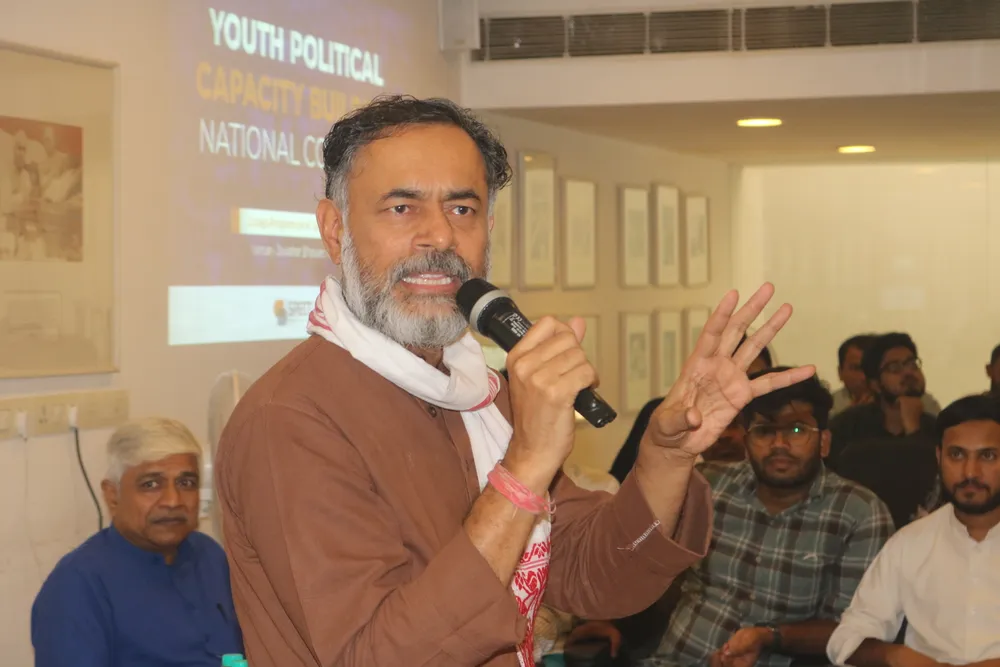
Yogendra Yadav, born Salim Yadav on 5 September 1963, is the rare Indian public intellectual whose career has run on two parallel tracks with almost equal weight: as one of the country's most influential election analysts (the psephologist who made it possible to talk scientifically about why voters in particular states vote the way they do) and as an activist-politician who moved from the anti-corruption movement of 2011 into the founding leadership of the Aam Aadmi Party, its very public 2015 expulsion, and the founding of his own party, Swaraj India. He is currently the national convener of the Bharat Jodo Abhiyan, the campaign that grew out of the Bharat Jodo Yatra, and he remained one of the most-quoted election predictors in Indian media through the 2024 general election. He has no family connection to the Yadav political dynasties of Bihar and Uttar Pradesh (his father was a professor of economics in a farming family from a village in present-day Haryana) but his career is inseparable from the study of the very communities, including Yadavs, whose rise he spent decades measuring at the booth level. This profile is drawn from his published academic record, dated media reporting and a continuously updated Wikipedia article used here as a cross-check.
Early Life: A Name Changed at Five
Yadav was born in Saharanwas, then in Punjab state and today part of the Rewari district of Haryana, into a family steeped in teaching: his paternal grandfather was a schoolteacher who was killed in a communal riot in 1936, when Yadav's father Devendra Singh was only seven, and his father went on to become a professor of economics. His birth name was Salim, a name his family says encoded a response to that communal killing, and which continued in domestic use among relatives and close friends. At the age of five he was being mocked at school for it, and the family changed the name to Yogendra. He has described himself as deeply shaped by the socialist thinker Kishen Patnaik, and the arc from classroom to agitation was, by his own account, never far from home. He studied at Rajasthan University (BA), Jawaharlal Nehru University (MA in political science) and Panjab University (MPhil); he is married to Madhulika Banerjee, a professor at the University of Delhi.
Building the Scientific Study of Indian Elections
Before he was a politician, Yadav was the person who taught Indian media what a psephologist was. He worked as an assistant professor of political science at Panjab University, Chandigarh, from 1985 to 1993. In 1995–2002 he was founder-convenor of Lokniti, a network of researchers studying elections in India's states, and from 1997 to 2003 he was founder-director of the CSDS-Lokniti research programme on comparative democracy at the Centre for the Study of Developing Societies, the programme whose post-poll survey data, released with co-researchers like Sanjay Kumar and Suhas Palshikar, reframed national conversations about caste arithmetic, welfare politics and the "anti-incumbency" patterns of state elections. He became a Senior Fellow at CSDS in 2004 and held the position until 2016. From 1996 onward he appeared as the election analyst on Indian television (Doordarshan, NDTV, CNN-IBN) a regular presence who turned the night of a result into a lecture on federal realignment. His edited and co-authored volumes, including State of Democracy in South Asia (2008), Electoral Politics in Indian States: Lok Sabha Elections in 2004 and Beyond (2009) and Making Sense of Indian Democracy: Theory as Practice (2020), plus his paper with Satish Deshpande redesigning affirmative action, form the citable backbone of this body of work; the Government of India's appointment of him to the National Advisory Council on the Right to Education Act in 2010 recognised the same expertise in policy space. His academic honours include the Malcolm Adiseshiah Award for Development Studies (2008) and the International Political Science Association's Global South Solidarity Award (2009).
The AAP Years: From Movement to Split
Yadav spoke publicly at the nationwide anti-corruption protests of 2011 and was a founding figure of the Aam Aadmi Party that grew out of them, serving on its National Executive. His simultaneous public role made him, in July 2011, a member of the University Grants Commission, an appointment the Human Resource Development Ministry forced him to give up in September 2013 over a perceived conflict of interest he publicly denied. A widely credited architect of AAP's strategy in its decisive 2013 Delhi assembly campaign (the brief 70-day government that followed) he contested the 2014 general election from Gurgaon, finishing fourth and losing his deposit. The rupture came in March 2015: voted out of AAP's Political Affairs Committee on 4 March, expelled from the National Executive on 28 March for alleged anti-party activity, and expelled from the party itself in April. His explanation, maintained ever since, was that he was victimised for challenging the "dictatorial ways" of the party's leadership under Arvind Kejriwal; AAP's account charged indiscipline. The split turned public property a quarrel that defined India's anti-establishment politics for a decade, and made the query "Yogendra Yadav AAP" one of the most-searched formulations of his name.
Swaraj India, Farmers and the Opposition Realignment
With Prashant Bhushan, the sociologist Anand Kumar and Ajit Jha, Yadav founded Swaraj Abhiyan, an organisation that campaigned on right-to-recall legislation, anti-corruption law reform and agrarian distress; it seeded the Jai Kisan Andolan and, in 2016, a registered political party, Swaraj India, of which he was founding national president. He urged Delhi's voters to mark None of the Above in the 2019 general election (recasting NOTA as "No Till an Alternative") after arguing that no contesting party had kept its promises. In 2020–21 he served on the coordination committee of the Samyukt Kisan Morcha that ran the year-long farmers' protest against the three repealed farm laws, one of the city's most visible faces at the Singhu border. When Rahul Gandhi walked the length of India in the 2022 Bharat Jodo Yatra, Yadav joined it, describing the south-to-north march as a "Dakshinayana" movement carrying southern political influences northward; the campaign's successor body, the Bharat Jodo Abhiyan, named him its national convener, a role he continues to hold. Through the 2024 general election cycle he was once again India's most-quoted independent election predictor, publishing a phase-wise forecast that The Week examined on the night of counting, an exercise in candour that has marked his forecasting career: some calls right, some famously wrong, all testable. On education he holds a distinctive position both critics and admirers cite: he opposes English-language dominance in higher education and equally opposes substituting Hindi, arguing instead for instruction in mother tongues, "bringing Hindi as a substitute for English is as barbaric to me as the dominance of English today."
Why He Matters to This Archive
Yadav matters to a Yadav-focused archive on two levels. In the search data, he is consistently among the most-looked-up bearers of the surname outside the Bihar–UP dynasties ("Yogendra Yadav age", "Yogendra Yadav AAP", "Yogendra Yadav current party") and this profile exists to answer those queries with sourced facts rather than rumour. In the scholarship, he is the analyst whose life's work (the CSDS-Lokniti state-election studies) generated the data that made the Yadav political rise measurable in the first place: the survey evidence on Other Backward Class mobilisation, on social justice politics in Uttar Pradesh and Bihar, runs through the very literature he built. The man who counted Yadav votes at the booth turned out to be as searchable as the men who commanded them. That intersection of community biography and political science is unique in this archive. The wider political context is in our politicians archive and our feature on the origins of the Yadav community.
How This Profile Was Verified
Dates, appointments, publications and honours in this profile were taken from the Yogendra Yadav article on Wikipedia and cross-checked against his professional profile at Brown University's Center for Contemporary South Asia (watson.brown.edu) and The Week's June 2024 report on his election forecast. The 2015 AAP expulsion is recorded with both parties' stated positions attributed. Family and birth-name details come from his own widely repeated public accounts as carried in the cited biography. This profile does not assert current membership of any legislature; as of the last verification date no sitting electoral office for him is documented in the sources cited. If any claim here is wrong, our corrections policy sets out how evidence-flagged fixes are processed, normally within 72 hours.