
Direct answer: Yadav is OBC, not General. Yadav/Ahir and its allied sub-groups are listed among the Other Backward Classes on the Central List of OBCs, which is the basis for OBC reservation in union-government jobs and central educational institutions. No state notifies Yadav as a General or forward category, and Yadav is not a Scheduled Caste or Scheduled Tribe, so the answer to "SC or OBC" is OBC as well. The one thing that can make the answer feel different from person to person is which state's list you read, because each state maintains its own OBC list and the entry name and coverage change with it. A second thing decides any individual case: the creamy-layer test, which applies to households and not to castes, and is explained below.
This page is the reservation-answer spoke of our Yadav caste cluster. The community background, the gotra, the kuldevta, the population and the Yadav Divas questions are covered on the cluster hub, the Yadav caste guide; the state-by-state comparison is on Yadav caste category by state.
Quick verdict table
| Category | Does Yadav fall in it? |
|---|---|
| General / Unreserved | No: not a notified General category, only a contested political demand. |
| Other Backward Class (OBC) | Yes: the working classification for reservation in most of India. |
| Scheduled Caste (SC) | No. |
| Scheduled Tribe (ST) | No. |
| BC / MBC (Tamil Nadu-style tiers) | The same wider community is handled inside these tiers in the south. |
| Economically Weaker Section (EWS) | A separate, caste-blind route; not a Yadav classification. |
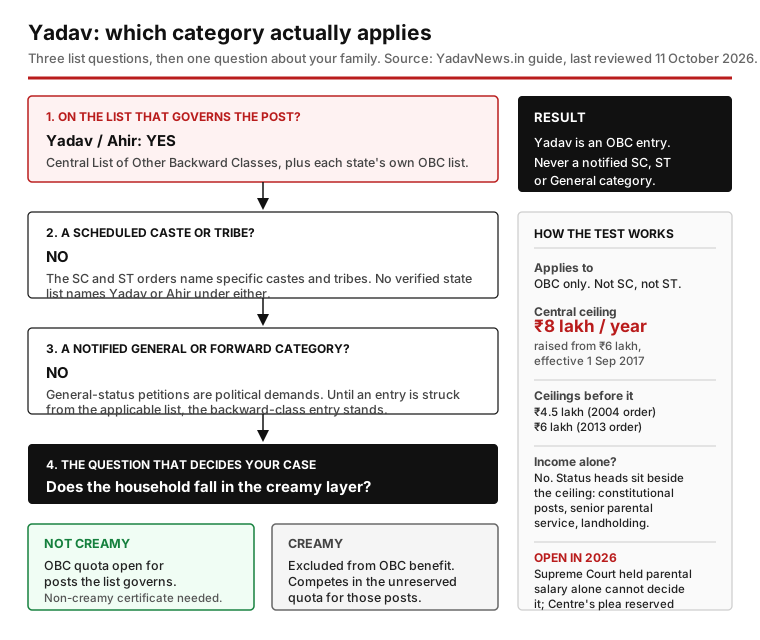
Why the answer is "OBC" and not "General"
Three facts settle the question, and they are worth separating because online answers routinely blur them.
- The national list says backward class. Yadav/Ahir appears on the Central List of Other Backward Classes, the list maintained for OBC reservation in central-government employment and union educational institutions. That is why a Yadav applicant for a central-government post is processed under the OBC quota, not the unreserved quota.
- No state notifies Yadav as General. The community is large and politically powerful, with a broad land-holding base, and sections of it have campaigned in several states for removal from OBC lists and recognition as forward, but a petition is a political position, not an entry in a notified order. Until an entry is struck from the applicable list, the classification stands.
- "General" in conversation usually means something else. When a family says "we are General" they typically mean their sub-group is socially forward or economically well-off. Neither is a legal category. Economic status can matter through the separate, caste-blind EWS route; it does not convert an OBC entry into a General entry.
Is Yadav SC or OBC? The two acronyms come from different lists
This is the second most-searched form of the question, and the short answer is: OBC. Yadav is not a Scheduled Caste. The confusion survives because an SC certificate and an OBC certificate look almost the same on paper, and because "SC" is used loosely in some regions as shorthand for any reserved category. The two categories are created by different instruments and they cannot be switched between.
| Scheduled Caste (SC) | Other Backward Class (OBC) | |
|---|---|---|
| Which list creates it | The Scheduled Castes Order made under the Constitution, with state amendments naming specific castes | The Central List of OBCs for union-government posts, plus each state's own backward-class list |
| What the list names | Individual castes, enumerated one by one | Classes held to be socially and educationally backward, often with sub-groups bundled in |
| Is Yadav or Ahir in it? | No. We found no state SC list that names Yadav or Ahir | Yes. Yadav/Ahir and allied sub-groups are carried on the central list |
| Reservation route | Seats and posts reserved for SC candidates | The OBC quota, subject in services to the creamy-layer exclusion |
| Document a recruiter wants | SC caste certificate from the competent authority | OBC certificate, and non-creamy-layer status where the post requires it |
The economic reading of the question is the one people get wrong. Falling below an income ceiling does not move a family from the OBC entry to the SC entry, and rising above it does not move anyone out of SC status either: the creamy-layer filter is applied inside OBC reservation only. That is also why "yadav sc hai ya obc" and "is yadav sc st or obc" resolve to one word. The Scheduled Tribes order names tribes, not the pastoral and landholding castes of the Hindi belt, so Yadav is neither SC nor ST. It is a backward-class entry, expressed as BC or MBC instead of OBC in Tamil Nadu and a few other southern states, which is covered on the state-wise category guide.
Central List vs state list: which one applies to you?
This is the distinction that decides the question for any individual, and the reason a single yes-or-no answer is misleading.
- Central List of OBCs, governs reservation in union-government jobs and central institutions (the all-India services and centrally-administered educational places). If a community is on the central list, that route is open nationwide for members of the listed group.
- State OBC list, each state maintains its own list and its own reservation rules for state government jobs and state institutions. A community may appear under a different name, be split into sub-entries, or be covered only through an allied caste name in a given state.
- Consequence: two people who both write "Yadav" as their surname can be treated differently if they belong to different sub-groups or are resident in different states. Check the list that governs the specific post or institution you are applying to: the central list for a union post, the state list for a state post. That is the only version of the answer that has operational effect.
- Certificate is the proof, not the surname. For any actual reservation claim, the operative document is a competent-authority OBC certificate recorded in the issuing format the recruiting body accepts. A surname, a community website list, or a family's self-description carries no administrative weight on its own.
What Yadav being OBC does and does not mean
Does: eligibility to be considered under OBC reservation in the jobs and institutions governed by the list that includes the entry, and eligibility to seek an OBC certificate from the competent authority.
Does not: create any automatic entitlement. OBC reservation within services is subject to the long-standing creamy-layer exclusion, which removes socially advanced individuals from OBC benefit, so two members of the same community can be treated differently depending on their family's status. Nor does an OBC entry make a person SC or ST, entitle them to those quotas, or confer any reservation in a state where the applicable list does not include their group. And it says nothing about an individual's gotra, sub-caste or village lineage, which are separate questions entirely.
Yadav and the creamy layer: the test that is about the family, not the caste
"Is Yadav in the creamy layer or not?" is one of the most-searched follow-ups to the category question, and the answer has to be split in two. No caste is a creamy-layer caste. Creamy layer is decided household by household against criteria the government notifies, and the same community certificate can carry reservation benefits for one family and none for another.
| What you are asking | What applies |
|---|---|
| Does the test touch Yadav at all? | Yes, in the same way it touches every OBC entry. OBC reservation in services excludes creamy-layer families. |
| Does it apply to SC or ST? | No. The creamy-layer filter sits inside OBC reservation only. |
| Central income ceiling | ₹8 lakh per annum, raised from ₹6 lakh with effect from 1 September 2017. |
| The ceilings before it | ₹4.5 lakh under Office Memorandum No. 36033/3/2004-Estt.(Res.), then ₹6 lakh under the 2013 order (No. 36033/1/2013-Estt.(Res.)). The limit is revised periodically, so the number is only as current as the notification behind it. |
| Income alone? | Not by the letter of the rules. Alongside the ceiling there are status heads carried in the Department of Personnel circulars since 1993: constitutional posts, senior and Group A service of the parents, substantial landholding and named professions. |
| Who decides in practice | The competent authority that issues the non-creamy-layer certificate. The recruiter reads the certificate, not this page. |
| Is the Yadav entry excluded wholesale? | No. Nothing in the list removes the community; exclusion is individual. |
What moved in 2026, and what is still open
The rule was under active change when this page was last reviewed. In Union of India v. Rohith N. Nathan the Supreme Court examined whether creamy-layer status can be fixed on parental salary income alone, and the reporting of the judgment is that it cannot: the income figure is one element of the test, and the Court read the other heads as part of the same decision (The Hindu explainer, 26 August 2026; Vision IAS note, 25 September 2026). The Union government then asked for clarification on the prospective operation of that ruling, and the Court reserved judgment on the plea on 25 September 2026.
YadavNews has not read the review order itself, so this page states the reported holding and the open plea instead of a settled position. For a Yadav applicant the practical reading is unchanged in one respect and unsettled in another: the non-creamy-layer certificate remains the document a recruiter examines, while the weight given to parental salary inside that decision is under judicial review. We will date any change if and when the order is published.
The General-category petition, stated fairly
The demand to move Yadavs out of OBC lists is real and politically significant, particularly in states where the community is among the largest OBC blocs. It rests on two arguments: that Yadavs are land-holding and over-represented in elected office, and therefore not backward in the sense the lists were written for; and, on the other side, that the community contains large numbers of poor, marginal-farmer as well as nomadic sub-groups, for whom the entry still works the way it was meant to. Both positions are contested in policy and in the courts. YadavNews reports this as an active dispute, not a settled fact: whatever the merits argued, the classification that applies today is the one currently on the relevant list.
What we label, and when this page changes
The central list and the state lists are revised independently, so an entry here is only as current as the notification behind it. The creamy-layer criteria are in a similar position with an extra complication: the ₹8 lakh central ceiling dates from a 2017 order, and the Supreme Court's 2026 ruling on whether parental salary alone can decide the question is still being litigated, with the Centre's plea reserved on 25 September 2026. Where a figure or an entry is an estimate and not a published order, we label it as such, and where a rule is under review we say so instead of presenting it as settled. This page is re-reviewed whenever an official list, a court order or a survey changes the underlying facts.