
Direct answer: in Bihar, Yadav is an Other Backward Class. The community is not a Scheduled Caste, not a Scheduled Tribe and not a notified General category in that state. Two different documents carry that answer, and reading them together is what makes the question settle instead of circulate: the Central List of OBCs names Yadav as its own entry for Bihar, and the Bihar government's own 2022 caste survey counted the community at 14.26% of the state, the largest share of any single group in the report.
This page covers one state. The all-India mechanics of the category question, including the creamy-layer test, are on Yadav OBC or General; the comparison across states is on Yadav caste category by state; the community background, gotra and kuldevta questions sit on the cluster hub, the Yadav caste guide.
What the notified list says, in Bihar's case
Reservation in India runs off lists, not off descriptions of a community, so the useful thing to publish is what the entry reads.
| Document | What it records for Yadav in Bihar |
|---|---|
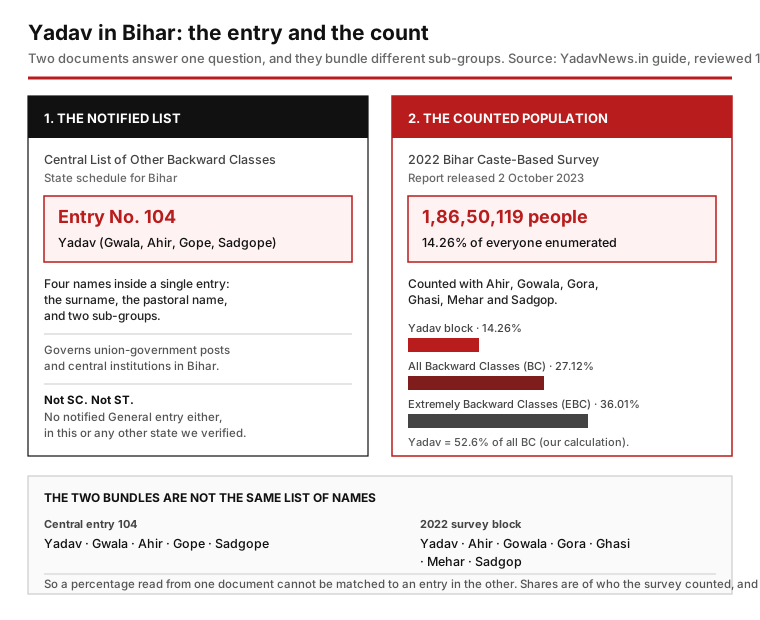
| Central List of Other Backward Classes, state schedule for Bihar | Entry No. 104 reads "Yadav (Gwala, Ahir, Gope, Sadgope)". Four names inside one entry: the Hindi-belt surname, the pastoral community name, and two sub-groups. |
| Bihar's own backward-class framework | The state splits its backward classes into Backward Classes (BC) and Extremely Backward Classes (EBC) and issues certificates in those labels, including the non-creamy-layer form. |
| 2022 Bihar Caste-Based Survey | A separate counting block: Yadav with Ahir, Gowala, Gora, Ghasi, Mehar and Sadgop, returned at 1,86,50,119 people, 14.26% of the enumerated population. |
The two lists are not copies of each other, and that difference is the most useful thing on this page. The central entry bundles Yadav with Gwala, Ahir and Sadgope. The state's survey bundles Yadav with Ahir, Gowala, Gora, Ghasi, Mehar and Sadgop. A person comparing a "Yadav percentage" from one document with an entry in the other is usually matching two different populations, and that is how arguments about Yadav strength in Bihar talk past each other.
How many Yadavs are there in Bihar?
14.26%, or 1,86,50,119 people, on the state's own enumeration. That is the largest share any single group holds in the report and the largest backward-class bloc in the state.
| Group as counted | People | Share |
|---|---|---|
| Total enumerated | 13,07,25,310 | 100% |
| Backward Classes (BC) | 3,54,63,936 | 27.12% |
| Extremely Backward Classes (EBC) | 4,70,80,514 | 36.01% |
| Yadav block (with five allied castes) | 1,86,50,119 | 14.26% |
| Scheduled Castes | 2,56,89,820 | 19.65% |
| Scheduled Tribes | 21,99,361 | 1.68% |
| Unreserved / General | 2,02,91,679 | 15.52% |
Two readings follow from those published figures, and both belong in the same sentence as the numbers. Yadav's 1,86,50,119 is 52.6% of the 3,54,63,936 people Bihar counted as Backward Classes, our calculation from the two figures the state published, which is why the community dominates BC politics in the state. And roughly 190 of the 214 castes the survey covered sit below 1%, the context that makes a 14% group legible at all.
Three limits travel with the number, and pages that quote it usually drop all three. It is a survey and not the census, so officials of the General Administration Department said during collection that some people would be missed; the percentages are shares of who was counted. The group is bundled, as set out above. And the count was disputed: on 5 October 2023 the BJP MP for Patna Sahib, Ravi Shankar Prasad, said nobody had met him or his family to collect caste information and implied the exercise had been manipulated to suit the RJD, Bihar's Information and Public Relations Department replied that his family's data was collected as per norm, and Tejashwi Yadav countered that Nitish Kumar would have inflated the numbers of his own Kurmi caste if the point had been to cheat. The figure we publish is the state's own.
BC, EBC or OBC: why Bihar uses three labels for one question
People search "yadav bc or obc in bihar" and "yadav comes under which category in bihar" because the paperwork and the national conversation use different words for the same position.
- OBC is the all-India word. It names the central list, and the central list is what governs reservation in union-government posts and centrally-administered institutions in Bihar as elsewhere. Entry 104 is the row that matters for those posts.
- BC and EBC are Bihar's words. The state maintains its own backward-class framework and divides it into Backward Classes and Extremely Backward Classes, with separate quotas. The state's 2022 survey reported the two tiers as different sizes: 27.12% BC and 36.01% EBC.
- Which one applies to a given applicant depends on the post. A union-government vacancy is read against the central list; a state-government vacancy is read against Bihar's list and Bihar's rules.
- Neither label is SC or ST. The constitutional orders for Scheduled Castes and Scheduled Tribes name specific castes and tribes, and Yadav or Ahir appears in none we could verify for Bihar. The category answer is backward class, full stop, and the general question on that distinction is on Yadav OBC or General.
Where Yadav sits between BC and EBC inside Bihar's own tiers is a state-list question we have not verified line by line, and this page says so instead of guessing.
The 65% quota: passed, struck down, still in court
The reservation percentage attached to these categories is itself unsettled, and a page that quotes "65% in Bihar" without the next sentence is out of date.
| Date | What happened |
|---|---|
| 2 October 2023 | The 2022 Bihar Caste-Based Survey report was released, the evidence base for the quota bill. |
| 9 November 2023 | The Bihar Assembly passed a bill raising reservation to 65%, excluding the 10% EWS quota, apportioned at 20% SC, 2% ST, 18% BC, 25% EBC and 10% for economically weaker sections among the upper castes. |
| 20 June 2024 | A division bench of the Patna High Court struck down the laws that took the quota to 65%, holding them in breach of the 50% ceiling set by the Supreme Court in 1992. |
| 2 July 2024 | The Bihar government moved the Supreme Court against that judgment. |
| 6 September 2024 | The Supreme Court sought the Centre's response on pleas against the High Court order, and the RJD filed its own, arguing on the basis of the survey that Bihar's backward-class population runs far above the national norm. |
So the honest answer to "how much reservation for Yadav in Bihar" is: the state legislature tried to move the total to 65%, the Patna High Court quashed that move, and the appeal is before the Supreme Court. Anyone citing a settled 65% is citing a law that a High Court bench has already voided, and anyone citing a settled 50% is ignoring that the matter is sub judice. YadavNews reports both halves and dates them.
How the certificate is actually obtained
A category claim in Bihar runs on a certificate, not on a surname. The service is delivered at district and sub-division level: the India.gov.in service listing for Bihar records that residents of SC, ST or OBC categories obtain the caste certificate from the District Magistrate or the Sub-Divisional Officer, and the state's RTPS online portal carries the application for residence, caste, income, BC/EBC (NCL), OBC (NCL) and EWS certificates at sub-division or district level.
Three practical points sit behind that. The NCL in the certificate name stands for non-creamy layer, the filter described on the reservation page, and Bihar issues the backward-class certificate in that form. The competent authority decides the individual case, so no website table, including the one above, stands in for it. And the recruiter reads the certificate against the list that governs the specific post, which is why the same Yadav applicant is processed under entry 104 for a union vacancy and under Bihar's own list for a state one.
Yadavs in Bihar's public life
The survey put Yadavs at 52 of the 243 seats in the Bihar Legislative Assembly, a figure from the state's own report and one reason the community sits at the centre of the state's coalition arithmetic. The counted result of that arithmetic, contest by contest, is on Yadav election results. The two figures our readers search for most from that politics are Tejashwi Yadav, the RJD leader and Deputy Chief Minister, and Lalu Prasad Yadav, the party's founder president. For the wider index of the community's public figures across states, see the Yadav personalities guide and our note on Yadav names in the news.
What we verified here, and what we did not
Verified against primary or government-hosted documents: the wording and entry number of Yadav's row in the Central List of OBCs for Bihar; the survey figures, which are the state's published returns; the certificate channel, from the India.gov.in service listing and the state's own portal; and the court dates, from legal-reporting sources dated as cited. Not verified by us, and marked as such above: which of Bihar's own BC or EBC tiers the Yadav entry occupies in the state list, and the text of the 2013 office memorandum that set the earlier ₹6 lakh creamy-layer ceiling. This page is re-reviewed whenever the Supreme Court decides the quota appeals, whenever Bihar revises its list, and whenever the central list is amended.