
The short answer: Yadav is classified as an Other Backward Class (OBC) category across the northern and western states where the name is used. In the southern states the same wider community sits inside the Backward Class / Most Backward Class (BC/MBC) tier system, usually under a regional name such as Idaiyar, Ayar or Golla instead of "Yadav". Uttar Pradesh and Bihar both treat the group as OBC, and Bihar is the only state with an official enumeration of Yadav population. State OBC lists are notified separately and revised independently, so each entry below carries one of two labels: verified, or not verified by us. Where we could not check a list, we say so.
This page is the state-wise spoke of our Yadav caste cluster. The general category question is answered on Yadav OBC or General, and the cluster hub, the Yadav caste guide, carries the community background, the gotra and kuldevta listings, and the Yadav Divas observance.
Community name and classification by state
| State / region | Community name used locally | Reservation frame | What we have verified |
|---|---|---|---|
| Uttar Pradesh | Yadav, Ahir | OBC (state list and central list) | Yadav/Ahir treated as an OBC bloc; no official caste census, so population share is an estimate only. |
| Bihar | Yadav, Ahir | OBC | Official: the 2022 Caste-Based Survey counted Yadav with Ahir, Gowala, Gora, Ghasi, Mehar and Sadgop at 18,650,119 people, about 14.26%, the state's largest OBC group. Full state page: Yadav caste category in Bihar. |
| Haryana | Ahir, Yadav | OBC | Ahir/Yadav are the recorded north-Indian names for the same community; gotra/clan names such as Dagar, Dahiya and Rathi recur here. List entry not verified by us. |
| Rajasthan | Ahir, Yadav | OBC | Ahir landholders and soldiers are documented through the Sultanate, Mughal and colonial periods. Specific current list entry not verified by us. |
| Madhya Pradesh | Yadav, Ahir | OBC | Part of the same Hindi-belt community family. Specific list entry not verified by us. |
| Maharashtra | Yadav, Ahir, Kunbi-Rao | OBC | Kunbi/Rao are the regional names inside the same wider family. Specific list entry not verified by us. |
| Delhi | Yadav, Ahir | OBC (central list applies to union-government posts) | Union territory administered under central-list rules for central posts. State-list specifics not verified by us. |
| Tamil Nadu | Idaiyar, Ayar | BC / MBC tiers | The state handles the community inside its own Backward Class / Most Backward Class framework, not a northern "Yadav OBC" entry, which is why "BC or MBC" is the local form of the question. Which tier a given sub-group sits in is not verified by us. |
| Andhra Pradesh & Telangana | Golla | State backward-class framework | Golla is the Telugu name for the same pastoral community family. The exact BC/BC-A/BC-D placement is not verified by us; check the state's published backlists. |
| Karnataka | Golla, Ahir, Kuruba-context names | State backward-class framework | Regional naming overlaps with Andhra and Maharashtra usage. List entry not verified by us. |
| Nepal (Terai) | Abir | Outside India's reservation system | The Terai branch of the community uses the Abir form of the name; Indian OBC categories do not apply. |
Read this table for the naming and the frame, not as a substitute for the official list. A reservation claim is decided by the notified entry in the list that governs the specific post or institution, plus an OBC certificate from the competent authority, never by a surname or a website table, including this one.
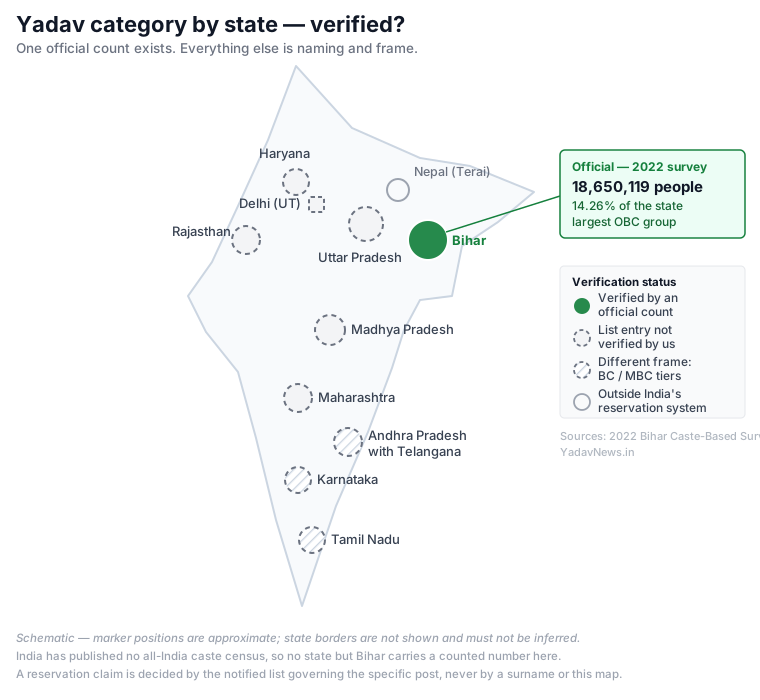
Why "in which state is Yadav general category?" has no positive answer
Searches asking for a state where Yadavs are General are looking for an exception. On the evidence available, there isn't a notified one: the community is entered in the backward-class framework in the states where it is enumerated, and the General-category recognition that some Yadav organisations have demanded remains a contested political claim, not a gazette entry. What genuinely varies between states is the name under which the group is listed, whether the entry is split into sub-groups, and (in the southern tier systems) whether a given sub-group sits in BC or MBC. Those differences change the paperwork; they do not convert the category to General anywhere we can verify.
Population: one official number, one unfinished all-India exercise, and a lot of estimates
A search for "Yadav population" expects one figure for one community across India. That figure has never been published by anyone. What actually exists is one state's official enumeration, an all-India exercise whose caste entries were never merged into a countable list, and several state surveys whose reports stayed in drawers. Each answers a different question. Putting their numbers in the same sentence is how one percentage ends up cited for Uttar Pradesh, for Bihar and for India by three different articles.
Bihar: the one official count, with its method attached
The 2022 Bihar Caste-Based Survey was notified by the Government of Bihar on 6 June 2022 by gazette notification, after a Supreme Court ruling. Collection began on 7 January 2023 and the report was released on 2 October 2023. The General Administration Department ran it, the state spent close to ₹5 billion from its contingency fund, and enumerators filed the data on a mobile application called Bijaga. It counted the 214 castes on the state's own list.
| What the survey reported | People | Share of those counted |
|---|---|---|
| Total counted | 13,07,25,310 | 100% |
| Backward Classes (BC) | 3,54,63,936 | 27.12% |
| Extremely Backward Classes (EBC) | 4,70,80,514 | 36.01% |
| BC and EBC together | 8,25,44,450 | 63.14% |
| Scheduled Castes | 2,56,89,820 | 19.65% |
| Scheduled Tribes | 21,99,361 | 1.68% |
| Unreserved / General | 2,02,91,679 | 15.52% |
The Yadav row comes down to this: counted together with its constituent castes, Yadav came out at 14.26% of the state's population, 1,86,50,119 people, the largest share any single group holds in the report and the state's largest OBC bloc. Around 190 of the 214 surveyed castes sit below 1%, which is the context that makes a 14% group politically legible: the survey report's own tally of legislators put Yadavs at 52 of the 243 MLAs in the state assembly.
Three limits belong next to that number, and most pages quoting it drop all three.
- It is a survey, not the census. Officials of the General Administration Department said during collection that some people would be missed, because the exercise was a sub-set of the census and could not be expected to reach 100% coverage. The percentages are shares of who was counted.
- The group is bundled. The entry lists Yadav with six castes counted alongside it: Ahir, Gowala, Gora, Ghasi, Mehar, Sadgop. A reader matching this 14.26% against a "Yadav" percentage from another country's or state's data is usually matching a bundled community against a bare surname.
- It was disputed. On 5 October 2023 the BJP MP for Patna Sahib, Ravi Shankar Prasad, said nobody had met him or his family to collect caste information and implied the survey had been manipulated to suit the RJD. Bihar's Information and Public Relations Department replied that his family's data was collected as per norm. Tejashwi Yadav's counter was that Nitish Kumar would have inflated the numbers of his own Kurmi caste if the point had been to cheat. Both the allegation and the rebuttal are on the record; the count itself is the state's published figure.
The enumeration moved policy in the same session it was produced, and then the courts moved it back. On 9 November 2023 the Bihar Assembly passed a bill raising reservation to 65%, excluding the 10% EWS quota, apportioned at 20% for SC, 2% for ST, 18% for BC, 25% for EBC and 10% for economically weaker sections among the upper castes. A division bench of the Patna High Court struck those laws down on 20 June 2024 for breaching the 50% ceiling set by the Supreme Court in 1992; the state appealed on 2 July 2024, and on 6 September 2024 the Supreme Court sought the Centre's response. So "65% in Bihar" is not a settled figure to quote, and neither is 50% while the appeal is sub judice. The dated timeline, the sources and the certificate route are on the state page, Yadav caste category in Bihar.
Uttar Pradesh: a large community with no count behind the number
Uttar Pradesh very likely holds the largest Yadav population in absolute numbers, described as running into the tens of millions. The shares commonly quoted for it, roughly 9-15%, are researcher and election-study estimates. Uttar Pradesh has never run a caste census and its Backward Classes work has been quota-focused, so no enumeration exists to check those estimates against. That is a statement about what is missing, not a claim that the estimates are wrong.
Why there is no India-wide Yadav number to find
Caste was last tabulated for the whole country in the colonial census of 1931. The 2011 exercise was a different thing. The Socio Economic and Caste Census was conducted for the Census of India by the Ministry of Rural Development between 2011 and 2015, and not under the 1948 Census of India Act, which made disclosure of caste voluntary instead of mandatory. It came back with 46,73,034 separate entries across caste, sub-caste, synonym, surname, gotra; every state received them in November 2014 and was asked to club them into something countable. On 28 July 2015 the government reported 8,19,58,314 errors in caste particulars, of which 6,73,81,119 had been rectified; a parliamentary committee said in August 2016 that 98.87% of the individual caste and religion data was error-free. In 2021 the central government described the data as outdated and inaccurate. No consolidated all-India caste table was ever published from it, so there is no all-India Yadav figure for anyone to cite, only re-derivations of Bihar's or nobody's.
Other states: surveys that ran and reports that stayed shut
| Exercise | Status | What is on the record |
|---|---|---|
| Kerala Socio-Economic Survey 1968 | Published | Until the 2011 exercise it was the only caste-based count in post-independence India. It put forward castes at 33% of the state, almost half of them Syrian Christians, and merged unrelated groups, which is why it is cited as a precedent so rarely. |
| Telangana Samagra Kutumba Survey 2014 | Report surfaced in 2022, findings not made public | Backward Classes at about 51% of a population near 3.69 crore, SC 18.48% and ST 11.74%. Detailed findings have not been released because of court cases against the survey. |
| Karnataka Social and Educational Survey 2015 | Unpublished as of 2023 | Ordered in 2014 to inform OBC reservations and run by the state Backward Classes Commission at a cost of ₹169 crore. It stayed unreleased through eight years and more than one government; in June 2023 the state said it would accept the report. |
| Uttarakhand OBC survey | Delayed, ongoing | Districts were found relying on outdated data instead of fresh door-to-door collection. The single-member commission cancelled flawed rounds, ordered redos and transferred officers, and had received no completed data even from Dehradun when the deadline slipped to June 2023. |
| Odisha Backward Classes survey 2023 | Started 1 May 2023, running at the point of reporting | Targeted the state's 211 notified Socially and Educationally Backward Classes across all 314 blocks and 114 urban local bodies. |
No state in that table, and no source we checked, publishes a Yadav percentage for Jharkhand, Madhya Pradesh, Haryana, Rajasthan, Maharashtra or Delhi. Their absence is the finding.
How to judge any Yadav population figure you meet elsewhere
- A Bihar share is official data with a stated method and an acknowledged undercount: 14.26%, 1,86,50,119 people, bundled with Ahir and five associated castes.
- An Uttar Pradesh, Jharkhand, MP, Haryana, Rajasthan, Maharashtra or Delhi share is an estimate. Say so in the sentence where you use it.
- An all-India Yadav number has no source at all. Anything precise enough to carry a decimal point is extrapolated from Bihar's survey or is a guess wearing a percentage sign.
Two questions settle out of this. The highest share is Bihar's, at 14.26%, from an official count. The most people live in Uttar Pradesh, on an estimate that no enumeration confirms.
Yadavs in public life, state by state
The community's political and cultural weight is most visible in Uttar Pradesh and Bihar, and our verified profiles show that distribution better than abstract percentages do.
- Bihar: Tejashwi Yadav and Lalu Prasad Yadav, the family at the centre of RJD politics and of the state's Yadav-vote debates.
- Uttar Pradesh: Akhilesh Yadav, Samajwadi Party leader and former chief minister; Kuldeep Yadav, the India left-arm wrist spinner; and Dinesh Lal Yadav "Nirahua", the Bhojpuri film and music figure from Ghazipur district.
- Maharashtra: Suryakumar Yadav, the India international batter from Mumbai, and Umesh Yadav, the fast bowler from Nagpur. Cricket profiles are where most "which caste" surname searches originate, because the surname is the only community signal visible in a scorecard.
- Haryana: Santosh Yadav, the mountaineer who climbed Everest twice.
- For the full index, see the Yadav personalities guide and our note on why surnames appear in Indian news coverage, Yadav names in the news.
For the deeper historical background (the Yaduvanshi claim, the Deccan Yadava dynasty of Devagiri and the Allahabad Pillar reference) read the origins of the Yadav community.
What would change this table
Every state whose notified list entry we could not confirm carries a not-verified flag in the table above. A Telangana release or a published Karnataka report would change those entries, and this page is re-reviewed whenever a state publishes or revises its backward-class list or runs a caste enumeration.