
Direct answer: Yadav is an Other Backward Class (OBC), not a General category. The Central List of OBCs carries Yadav or Ahir, often bundled with Gwala, Gope and allied sub-groups, as its own entry in every state schedule we read, and that list decides reservation in central-government jobs. The entry that applies to a family is its own state's.
There is no all-India General status for Yadavs, and there is no all-India exception either, which is why two people both surnamed Yadav can sit under differently worded entries. The community's widely made claim to General or forward status is a live political demand, not a notified fact. One further filter decides any individual case: the creamy-layer test, which runs on the household and not on the caste. The table below quotes what the notified central list actually says, entry number and all, so the answer stops being a description and becomes a row you can check.
| Your question | One-line answer |
|---|---|
| Is Yadav OBC or General? | OBC in most of India; the state list decides. |
| Which category is Yadav? | Other Backward Class (OBC); Tamil Nadu handles it as BC/MBC. |
| What is the Yadav caste category in your state? | Verified entry numbers for 14 states and union territories are in the table below; the rest are flagged not verified. |
| Is Yadav OBC for central government jobs? | Yes. The Central List of OBCs is the list that governs union-government posts and central institutions. |
| Is Yadav SC or OBC? | OBC. Yadav appears in no state's Scheduled Caste list we could verify. |
| Is Yadav BC1 or BC2? | Neither label is the central list's. Bihar divides its own list into BC and EBC; Jharkhand uses BC-I and BC-II. Which tier, we flag per state below. |
| Is Yadav a high caste? | Ritual varna is contested (Kshatriya claim vs Shudra record); legally it is OBC. |
| Yadav in Bihar / UP? | OBC in both; Bihar's 2022 caste survey counts Yadavs at 14.26%. |
| Yadav in Tamil Nadu, BC or MBC? | Handled inside the state's BC / MBC tiers; the central list still names Yadava there. |
| How many Yadav gotras? | There is no single Yadav gotra and no officially confirmed count. |
| Who is the Yadav kuldevta? | Principally Krishna, with regional and family kuldevtas on top. |
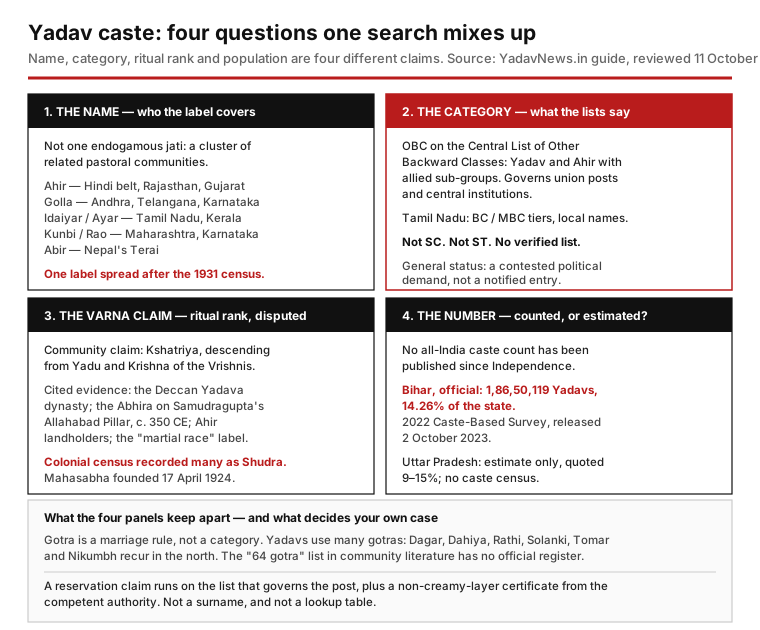
This page is the hub of our Yadav caste and community cluster. The narrow questions each have their own verified page: Yadav OBC or General: the reservation answer, Yadav caste category by state, the Bihar category and caste-count page, and the gotra and varna guide. The counted vote and seat numbers behind the community politicians people search for after an election are on Yadav election results. The long-form legend, the inscriptions as well as the dynasty live separately in the origins of the Yadav community. This guide is also published in Hindi, as यादव जाति मार्गदर्शिका.
Yadav caste category by state: what the notified list actually says
Reservation runs off lists, not off descriptions of a community, so the useful thing to publish is the entry text. We read the state schedules of the Central List of Other Backward Classes as they are hosted by the National Commission for Backward Classes and the Ministry of Social Justice and Empowerment, on 14 October 2026. The wording below is quoted from those rows, with the resolution numbers and dates printed beside them.
| State / Union Territory | Entry No. | Wording on the central list row | Resolution dates on that row |
|---|---|---|---|
| Uttar Pradesh | 1 | Ahir, Yadav | 10/09/1993; amended 06/12/1999 |
| Bihar | 104 | Yadav (Gwala, Ahir, Gope, Sadgope) | 10/09/1993; amended 13/01/2004 |
| Delhi | 3 | Ahir, Yadav, Gwala | 24/05/1995 |
| Haryana | 26 | Gawala, Gowala, Ahir/Yadav | 10/09/1993; 06/12/1996 |
| Rajasthan | 1 | Ahir (Yadav) | 19/10/1994 |
| Madhya Pradesh | 1 | Ahir, Brajwasi, Gawali, Goli, Lingayat-Gaoli, Gowari, Gowra, Gawari, Gwara, Jadav, Yadav, Raut, Thethwar, Gop/Gopal, Bargahi, Bargah | 10/09/1993; 15/05/1995; 16/06/2011 |
| Gujarat | 2 | Ahir (row also carries Ayar Bericha) | 10/09/1993 |
| Maharashtra | 172 | Yadav, Ahir | 10/09/1993 |
| Jharkhand | 118 | Yadav (Gwala, Ahir, Gope), Mehar, Sadgop | 18/08/2010; 08/12/2011 |
| West Bengal | 3 | Goala, Gope (Pallav Gope, Ballav Gope, Yadav Gope, Gope, Ahir and Yadav) | 19/10/1994; 27/10/1999 |
| Karnataka | 22 | Golla, Gouli, Lingayat Gowli/Gauli/Kawadiga, Gavali, Gavli, Konar, Konnur, Krishna Gavali, Gopal, Yadav, Asthanagolla, Yadava, Adavigolla, Gopala, Gopali, Maniyani | 10/09/1993; 06/12/1999; 18/08/2010 |
| Andhra Pradesh | 93 | Yadava (Golla) | 10/09/1993 |
| Tamil Nadu | 168 | Yadava (including Idaiyar, Telugu-speaking Idaiyar known as Vaduga Ayar or Vaduga Idaiyar or Golla, Mond Golla and Asthanthra Golla) | 10/09/1993; 15/05/1995 |
| Kerala | 82 on the state schedule, mapped to central list entry 67 | Yadava (Kolaya, Ayar, Mayar, Maniyani and Iruman) | as printed on the schedule |
Three things fall out of reading the rows instead of summarising them.
The name changes, the position does not. A northern applicant is entered as Yadav or Ahir; a southern applicant is entered as Yadava, Golla, Idaiyar or Ayar. Tamil Nadu and Kerala are the clearest cases, and both are on the central list under the southern spelling, which surprises readers who assume "Yadav OBC" is a Hindi-belt idea only.
The bundles are not interchangeable. UP's entry is two names. MP's is sixteen. Bihar's is four inside brackets, and the state's own 2022 caste survey bundles a different six. Comparing a percentage drawn from one document with an entry in the other is the single commonest error in this topic, and it is why Yadav population arguments talk past each other.
Several lists carry a surnamed variant alongside the community name, such as Jadav in Madhya Pradesh. That is a synonym on a list, not proof that a particular family sits under it.
Not verified. We could not retrieve a government-hosted schedule we were willing to quote for Telangana, Odisha, Uttarakhand, Punjab and Himachal Pradesh. Two notes on that: the Punjab schedule we read lists Aheria/Aheri, which is a different community, and we publish that as "we found no row to quote" rather than as proof of absence. The Jharkhand row carries a 2011 amendment filed under a number that includes the string "B.C.II"; that is a notification reference, and we do not read it as a statement that Yadav is a BC-II caste in Jharkhand's own state list. Where an entry sits on a state's own list rather than the central list is a separate check, set out state by state on Yadav caste category by state.
Central government or state government: the list that governs the post
"Yadav caste category for central government" is a distinct search, and it has a distinct answer, because two different lists are in play at once.
- Central List of OBCs. Maintained by the central government, and it is the list that governs reservation in union-government posts, the all-India services and centrally-administered educational institutions. Every row in the table above is from it. If Yadav or Ahir appears on your state's schedule of this list, the OBC quota on a central vacancy is read against that row.
- State OBC list. Each state maintains its own backward-class list and its own reservation rules for state-government posts and state institutions, and Bihar and Jharkhand go further and subdivide theirs into tiers. A community can be entered on both lists under different wording.
- The practical consequence. A Yadav applicant in Uttar Pradesh competing for a union-government post is processed under entry 1 of UP's central-list schedule; the same applicant for a state post is processed under UP's own list and UP's own rules. Neither list is a copy of the other, and a surname settles nothing on either side, because the document a recruiter reads is the certificate, not the family name.
- What stays the same across both. Yadav is a backward-class entry on the central list wherever we found it, and it is not entered on any Scheduled Caste or Scheduled Tribe list we checked. The general-category recognition some Yadav organisations have sought has not been notified for the centre or for any state we verified.
Did the Yadav caste category change in 2025 or 2026?
Searches phrased as "Yadav caste category in Bihar 2025" are usually asking a current question in old words, so the useful answer is what changed and what did not, with dates.
The classification did not change. Every row quoted in the table above still carries the resolution date on which it was notified, and the most recent amendment we found on any of them predates 2025. The ministry's central-list page was last updated on 17 June 2026 and still publishes the same state schedules, with no 2025 or 2026 amendment striking or re-tiering the Yadav, Ahir, Golla or Idaiyar rows we read. So a 2025 answer and a 2026 answer to "which category is Yadav" are the same answer: backward class, on the list that governs the post.
What did move is everything around it. Bihar's 2022 caste-based survey was published in October 2023 and produced the 14.26% figure, the state legislature then took total reservation to 65% in November 2023, the Patna High Court struck those laws down on 20 June 2024, the state appealed on 2 July 2024, and the Supreme Court sought the Centre's response on 6 September 2024. Nationally, the creamy-layer test that decides individual Yadav applicants was under review in 2026, with the Supreme Court's judgment in Union of India v. Rohith N. Nathan reported as holding that parental salary cannot decide the question on its own, and the Centre's clarification plea reserved on 25 September 2026. A reader asking about "2025" is therefore asking about a stable category inside a moving quota and creamy-layer picture, and the two should not be reported as one story. The quota timeline is on the Bihar page and the creamy-layer detail on Yadav OBC or General.
Which caste are Yadavs, and what does the name cover?
Yadav is not a single endogamous jati in the strict sense. It is a consolidated identity that sits over a cluster of related communities who share an origin story traced to Yadu, a legendary king of the lunar (Chandravanshi) line in Sanskrit epic and Puranic literature, and to Krishna of the Vrishni clan. Depending on region, people inside this family may identify as Ahir (the Hindi belt, Rajasthan, Gujarat, Sindh), Golla (Andhra Pradesh, Telangana, Karnataka), Idaiyar or Ayar (Tamil Nadu, Kerala), Kunbi or Rao (Maharashtra, Karnataka), Abir (Nepal's Terai), or simply Yadav. The single "Yadav" label spread because the community's own early-twentieth-century organisations chose it and the colonial census recorded it. The regional names and distribution are summarised, with sources, at Wikipedia's article on the Yadav community.
Is Yadav OBC or General category?
This is the single most-searched Yadav-caste question, and the honest answer is: OBC in most of India, but the state list decides, and the community petitions for General status.
- Central (All-India) lists: the Central List of Other Backward Classes carries Yadav and Ahir alongside their allied sub-groups, and that list is the basis for OBC reservations in union-government jobs and central educational institutions. So at the national level Yadavs are treated as OBC, not General.
- State lists differ: each state maintains its own OBC list, so a group that is OBC in Uttar Pradesh or Bihar may be entered under a different label, sub-categorised, or (rarely) excluded elsewhere. Because the entry name and the sub-group coverage change with the state, "yadav caste category in [state]" searches have state-specific answers, we set those out side by side on the state-wise category guide.
- The General-Category demand: Yadavs are a large community that holds land and wields political power in several states, and sections of them have campaigned in several states for removal from OBC lists and recognition as General or forward, the flip side of the same reservation politics that put them on those lists. This is an active, contested policy issue, not a settled fact.
So "yadav obc or general" has no universal yes/no. OBC is the working default for reservation purposes, General is a contested claim, and the state list is what actually applies to any individual. The eligibility mechanics, the "SC or OBC" question and the creamy-layer test that decides individual cases are worked through on Yadav OBC or General.
What the category labels mean: OBC, EBC, BC-I, BC-II, BC-A, BC-B, MBC and General
Half of the confusion in Yadav caste searches is vocabulary. The same position is written differently depending on which list and which state is doing the writing, so a reader hunting "Yadav BC1 or BC2" is often asking about a tier system that the list in front of them does not use.
| Label | Who uses it | What it means | Where Yadav sits |
|---|---|---|---|
| OBC (Other Backward Class) | Centre and most northern/western states | The single backward-class tier on the Central List of OBCs and on most state lists | Entered here, under Yadav, Ahir, Gawala or Golla depending on state |
| BC and EBC | Bihar | Bihar's own two-tier split of its backward classes: Backward Classes and Extremely Backward Classes | Yadav is a backward-class entry; which Bihar tier, we have not verified on the state list |
| BC-I and BC-II | Jharkhand | Jharkhand's own two-tier split of its state list | Not the same thing as Bihar's BC/EBC; the Yadav tier there is not verified |
| BC, BC-A, BC-B | Andhra Pradesh and Telangana | The state's backward classes, with Group A and Group B carved out for further-depressed groups | AP's central-list row is Yadava (Golla); the state's own group is not verified |
| BC and MBC | Tamil Nadu | Backward Class and Most Backward Class, the state's own tiers | TN's central-list row names Yadava with Idaiyar and Golla; the state tier is not verified |
| General / Unreserved | Everywhere | Not a reservation category at all: the pool with no quota | No notified entry calls Yadav General |
| SC / ST | Constitutional orders | Named castes and named tribes, on separate lists | Yadav appears in none we could verify |
| EWS | Centre and states | A caste-blind economic route, open to non-OBC candidates | Not a Yadav classification; a route some applicants may use |
The one point worth carrying away: BC-I, BC-II, BC-A, BC-B and MBC are state vocabulary, and the central list does not use them. A question phrased in those words cannot be answered from the central list at all, and must be answered from the specific state's own backward-class list, which is exactly what the certificate a district authority issues is drawn from.
Is Yadav BC or MBC?
"BC or MBC" is a Tamil Nadu and South Indian framing, not a northern one at all. Southern states classify backward communities inside their own Backward Class (BC) and Most Backward Class (MBC) tiers instead of using the "Yadav OBC" entry found in the Hindi belt, which is why "yadav caste in Tamil Nadu BC or MBC" searches get a BC or MBC answer instead of an OBC one. Two documents are involved and they say different things. The central list row for Tamil Nadu does name the community, at entry 168, as Yadava including Idaiyar and the Telugu-speaking Idaiyar known as Vaduga Ayar or Golla. The state's own BC or MBC tier for that same row is a separate question, decided by Tamil Nadu's backward-class lists, and we have not verified it line by line. The same split applies in Kerala and Karnataka, where the registers name Yadava with Ayar, Maniyani and Golla on the central row while the state tier goes unchecked. The north-versus-south difference is mapped state by state, with every unverified entry flagged as such, in the state-wise category guide.
Is Yadav a Scheduled Caste or a General-category caste?
No: Yadav is not a Scheduled Caste (SC) and not a Scheduled Tribe (ST). The constitutional SC and ST orders name specific castes and tribes, and Yadav or Ahir does not appear in them; Yadavs sit in the backward classes (OBC, or BC/MBC in the south). Nor is Yadav a notified General or forward category in the states where it is listed. The three questions people collapse into one ("is Yadav high caste", "is Yadav SC", "is Yadav general") therefore have three different kinds of answer: the SC and ST question has a settled administrative answer of no, the General question is a contested political claim, and the "high caste" question is a ritual-varna debate covered below.
How to check the official Yadav caste category list for your state
Anyone can run this check, and it takes about ten minutes. It is also the only route that settles a category question, because a website table, including the one above, is evidence of what a list said on the day we read it, not a substitute for the list that governs the post in front of you.
- Fix which list applies. A union-government post or a central institution is read against the Central List of OBCs. A state-government post or state institution is read against that state's own backward-class list. Two different documents, so identify the one that governs the vacancy before checking any name.
- Open the state schedule of the central list. The National Commission for Backward Classes publishes the state-wise central lists, and the Ministry of Social Justice and Empowerment maintains the same schedules on its own site. Read the row itself, not a summary of it.
- Search under the name the list uses, not the name your family uses. Yadav, Ahir, Gawala, Gowala, Gwala, Gope, Sadgop, Golla, Yadava, Idaiyar or Ayar. The spelling is the list's choice, and it is the main reason people conclude, wrongly, that their community is missing from the list.
- Write down the entry number and the resolution dates printed on that row. A dated row is a checkable claim; an undated one is a rumour. The resolution number is what you quote if you ever need to show your working.
- Check for a later amendment beside the original row. Rows are amended, and the amendment sits next to what it changed, as UP's 1999 entry and Bihar's 2004 entry do. The government's central-list page carries its own last-updated date; treat anything older as provisional.
- For a state post, then check the state's own list on that state's backward-class commission site, and see whether the state divides its tier into BC and EBC, BC-I and BC-II, or BC-A and BC-B. That division is where "BC1 or BC2" style questions are actually answered, and the central list cannot answer them.
- Finally, produce the document that decides. A caste or OBC certificate from the competent authority in the format the recruiting body accepts, plus a non-creamy-layer certificate where the post requires one. No list entry helps an applicant who cannot produce the certificate, and no certificate pre-empts the authority's decision on the individual case.
The certificate route, the office that signs and the portal that carries the form, is worked through for one state on Yadav caste category in Bihar.
Are Yadavs Kshatriya or Shudra?
The community's self-image and the colonial record disagree, and that gap explains most of the online debate.
Yadavs claim Kshatriya (warrior) status, tracing descent from Yadu and Krishna, and they point to a ruling and military record behind the claim: the Deccan Yadava dynasty of Devagiri; the Abhira named in Samudragupta's Allahabad Pillar inscription, dated about 350 CE, in its list of tribal states whose heads acknowledged him with tribute and obedience; Ahir landholders and soldiers across the Sultanate and Mughal centuries; and the colonial "martial race" designation that won Ahirs a place in recruitment. Read those old labels carefully, because neither is a varna verdict. The inscription counts the Abhira with the tribal republics, alongside the Yaudheyas, and says nothing about ritual rank or soldier castes. "Martial race" was a British administrative sorting that graded communities as martial or non-martial, and the Ahirs of Punjab were returned as an "agricultural tribe" in the 1920s, a term that then served as a synonym for martial. Our long-form account of the inscriptional evidence is the origins of the Yadav community.
The colonial census operations, however, treated many Ahir and Yadav groups as Shudra, partly because of their pastoral and nomadic occupation, and it was in the 1931 census that the cow-keeping castes of northern India successfully combined under the single label Yadava. That classification fed the early-twentieth-century Sanskritisation movement. Community bodies, above all the All India Yadav Mahasabha founded on 17 April 1924, campaigned to be recorded as Yaduvanshi Kshatriyas, adopted the "Yadav" surname, and built the genealogical and temple-based evidence for the higher claim. Wikipedia's Yadav article states the tension plainly: the community is accorded Shudra status in the classical varna scheme "although the community's members often claim the higher status of Kshatriya."
Bottom line: in ritual varna terms the historical record is genuinely contested, in modern legal-administrative terms Yadavs are OBC, and in self-identity the Kshatriya Yaduvanshi claim is the dominant one. Our fuller treatment of the gotra, sub-caste as well as varna evidence sits at the gotra and varna guide.
Yadav surname: is every "Yadav" the same caste?
The surname is an umbrella, not a single jati, so "yadav surname caste" has to be answered in two directions. From caste to surname: people carrying the Yadav surname are, in the overwhelming majority of cases, members of the Yadav and Ahir community family described above and are covered by the same OBC entries. From surname to caste: the reverse does not hold. Many community members never use "Yadav" as a surname at all, using Ahir, Golla, Idaiyar, Kunbi, Rao, or a local clan or gotra name such as Dagar, Dahiya or Solanki instead, and a Yadav surname alone does not establish an individual's gotra, sub-group, or which state list applies to them. The full treatment, including why the name is a weak caste detector and what a surname can and cannot settle, is on its own page: Yadav surname and caste. Public figures show why that matters: surname-based searches such as "suryakumar yadav which caste" or "kuldeep yadav caste" reflect the same consolidated community identity documented here, and what we verify with sources is their public record, see the profiles of Suryakumar Yadav, Kuldeep Yadav, and the wider Yadav personalities guide. An individual's gotra or state-list entry is a private family detail, and we do not speculate about it.
Yadav population: how many Yadavs, and where?
First, the most important caveat for accuracy: India has not published a caste-wise population count since Independence. The decennial Census enumerates Scheduled Castes and Scheduled Tribes but does not release an all-caste tally, so any "Yadav population" figure is either a state caste survey or a researcher's estimate, not an official national number. Anyone quoting a precise all-India figure is extrapolating.
What we can cite:
- Bihar is the official count. The 2022 Bihar Caste-Based Survey, published in October 2023, counted Yadav together with the sub-groups Ahir, Gowala, Gora, Ghasi, Mehar as well as Sadgop, at 1,86,50,119 people, about 14.26% of the state's population, which makes Yadavs the largest Other Backward Class group in Bihar. This is the single most reliable Yadav population figure available for any Indian state because it is a completed, official state enumeration.
- Uttar Pradesh is an estimate. UP almost certainly holds the largest Yadav population in absolute numbers, widely described as running into the tens of millions and roughly a fifth of the OBC population in some estimates. UP has had no official caste census, so its percentage share comes from researchers and election-study bodies as a range, not a fixed figure. Treat "yadav percent in UP" claims, commonly quoted anywhere from about 9% to 15%, as estimates, not counts.
- All-India: advocacy and community sources sometimes claim Yadavs and allied castes together form on the order of 20% of India's population. The honest framing is that the Yadav family of castes is among India's largest social blocs, but there is no verified national percentage.
Answering the two most common sub-questions directly: the highest Yadav share belongs to Bihar, about 14% on the official survey, and the most Yadavs in raw numbers live in Uttar Pradesh. The recurring "up me yadav kitne percent hai" and "bihar me yadav kitne percent hai" queries resolve to: no official UP figure exists, and Bihar's official 2023 survey says about 14%.
What is the Yadav gotra?
There is no single "Yadav gotra". Gotra, the patrilineal clan lineage used mainly in marriage rules, varies widely by region and sub-community, and Yadav and Ahir gotra lists are locally maintained, not nationally codified, so be sceptical of any list claiming to be exhaustive or authoritative.
What is broadly consistent:
- Many Yadav families trace a symbolic lineage to Yadu and the Chandravanshi (lunar) line, and some adopt the classical Saptarishi gotras (Kashyap, Atri, Vashisht, Vishvamitra, among others) common across "twice-born" claims.
- Region-specific gotra and clan names recur in north Indian Ahir and Yadav lists, especially those of Haryana and Rajasthan as well as western UP. Names such as Dagar, Dahiya, Rathi, Banaphar, Apharia, Solanki, Tomar, Nikumbh, Bagria or Babria, Phatak as well as Pancholi appear across community compilations, and those are clan and sub-group labels as much as brahmanical gotras.
- Some communities recognise a traditional set, often a larger number of gotras such as the "64 gotra" framing popular in community literature, but no official register confirms a fixed count.
For "yadav ka gotra kya hai" the accurate answer is that it depends on your family and region: Yadavs use many gotras, and your kuldevta and marriage rules are tied to the specific one. Verification for an individual gotra should come from family records or a reliable community register, not a web list. The gotra and sub-caste evidence in more detail, including the "how many gotra" question, is on the gotra and varna guide.
How many sub-castes are there in the Yadav community?
There is no officially enumerated, fixed number. What exists instead is a set of overlapping classifications, each with its own list, and conflating them is the main reason "how many types of yadav caste" never resolves to one number:
- Regional community names for the same wider family (Ahir, Golla, Idaiyar or Ayar, Kunbi or Rao, Abir) as listed above.
- Survey sub-groups. Bihar's 2022 Caste-Based Survey is the only official list we can point to, and it counts Yadav together with Ahir, Gowala, Gora, Ghasi, Mehar as well as Sadgop as a single 14.26% bloc, that is, an official enumeration recognises at least those constituent castes without treating them as separate categories.
- Clan and gotra names such as Dagar, Dahiya, Rathi, Banaphar, Solanki, Tomar as well as Nikumbh, which are sub-group identities in the north.
- Community-literature totals such as the popular "64 gotra" framing, which no official register confirms.
So the defensible answer is that the Yadav identity is a cluster of castes and clans whose membership varies by who is doing the counting: the census, a state backward-class list, or a community register. Details and per-name coverage are in the gotra and varna guide.
Kuldevta and worship
A kuldevta or kuldaivat is a clan's patron deity, and for Yadavs the devotional centre is overwhelmingly Krishna, the human form of Vishnu born to the Yadavas, whose childhood among the cowherds of Braj makes him the natural focal deity of a community that remembers itself as his kin. Living expressions include the Laddu Gopal tradition of Braj, reverence for the cow as Krishna's animal, and pilgrimage pride in Dwarka.
Beyond Krishna, regional kuldevtas vary: many Ahir and Yadav families in Rajasthan and Haryana as well as western UP also venerate local hero-deities and forms of Bhairon Baba, Shiva, Burha or Ajagar ancestor figures, and family Devi (shakti) forms. As with gotra, the specific kuldevta is a matter of family and region, so treat any single-name answer as partial.
Yadav Divas: when is it, and is it official?
"Yadav Divas" (Yadav Diwas) is advertised by community bodies and well-wishers on 15 April each year as a day for Yaduvanshi identity, the lineage of Yadu and Krishna and the community's social history. Two things have to be separated. The date is a community convention, not something we could source: we found no dated report, no public organisational calendar and no government notification fixing 15 April, the claim travels mainly through social-media posts, and the origin stories attached to it differ between organisers. The status is clearer: Yadav Divas is a community-led commemoration, and we have seen no union or state notification making it a public holiday. What is documented is the adjacent institutional date, the founding of the All India Yadav Mahasabha on 17 April 1924, the body that drove the Yaduvanshi Kshatriya campaign; mid-April carries weight for Yadav organisations because of that movement, and no authority has decreed a holiday behind it. So the honest answer to "yadav divas kab manaya jata hai" is that community groups mark 15 April, treat it as a cultural observance, and do not confuse it with a state holiday.
Can two Yadavs marry in the same gotra?
Traditional Yadav and Ahir marriage practice follows the wider North Indian Hindu norm of gotra exogamy: a couple should not belong to the same gotra, and in many families not the same clan or vansh either, even though both may be Yadav. Customs are not uniform: northern Ahir usage stresses gotra exogamy, while Golla and Idaiyar communities follow their own local rules. This is what sits behind searches like "can two Yadavs marry" or "same gotra marriage". Same-surname marriage is not barred by the surname itself; within the community the gotra and, in orthodox practice, the lineage are the operative rule. The statute works differently. The Hindu Marriage Act restricts marriage within the degrees of prohibited relationship and, where the custom applies, within sapinda ties; it does not itself impose gotra exogamy, which is a customary rule enforced by community practice and by marriage-registration paperwork, not by the Act's own text. Sharing the "Yadav" surname is therefore no legal impediment, and many marriages between two Yadavs take place across different gotras.
What this page labels, and when it changes
The category rows above are quoted from the state schedules of the Central List of OBCs as hosted by the National Commission for Backward Classes and the Ministry of Social Justice and Empowerment, read on 14 October 2026, each with its own entry number and resolution dates. Those lists are amended from time to time, and a row quoted here is evidence of the position on that date, not a standing guarantee.
Three kinds of claim on this page are deliberately labelled rather than smoothed over. Population figures for states that have never run a caste census are shown as estimates, and the Yadav Divas date is shown as an unverified community convention. Which tier a Yadav row occupies inside a state's own subdivisions, Bihar's BC or EBC, Jharkhand's BC-I or BC-II, Andhra Pradesh's BC-A or BC-B, Tamil Nadu's BC or MBC, is marked not verified, because we did not read those state lists line by line. And the General-category demand is presented as a contested political claim, not as a classification.
Where a reader needs a decision rather than a description, the operative documents are the list that governs the specific post and the certificate the competent authority issues, and the procedure for getting both is set out above. This guide is re-reviewed whenever an official list, a court order or a survey changes the underlying facts.