
Direct answer: the surname Yadav marks the Yadav and Ahir community family, which is classified as an Other Backward Class in the states where that family is enumerated. It is a reliable signal of that community in the Hindi belt and a poor one everywhere else, because "Yadav" is a name large parts of the community adopted during the twentieth century instead of inheriting. Many families inside the same community carry a different name altogether, and no Indian surname by itself settles a person's sub-caste, gotra, home state or reservation category. Those four things are settled by family record, domicile and a certificate, in that order.
This page is the surname spoke of the Yadav caste cluster. The category question at national level is answered on Yadav OBC or General, the community background and the kuldevta and population questions sit on the cluster hub, the Yadav caste guide, and the gotra and sub-caste evidence is on the gotra and varna guide.
What the Yadav surname actually marks
Yadav is the modern umbrella name for a family of related communities who were historically pastoral and farming, carry a warrior record in many regions, and share an origin account traced to Yadu and to Krishna of the Vrishni clan. In the Hindi belt, Rajasthan, Gujarat and the Nepali Terai the older name for the same people is Ahir. In the south the cognate communities are Golla in Andhra Pradesh, Telangana and Karnataka, Idaiyar and Ayar in Tamil Nadu and Kerala, and Kunbi or Rao in Maharashtra. The Terai branch spells the name Abir.
So when a reader asks "yadav surname belongs to which caste", the honest reply is that the surname and the community name are the same word. Yadav names the community; it does not sit above the community as a family label the way, say, Sharma sits above several brahmanical jatis.
Why the surname is a weak caste detector
Two documented facts make the inference one-directional, and they are the reason pages that answer this question with a flat "Yadav means OBC" keep getting the search wrong.
First, the consolidated label is a census product. The colonial census operations classified many Ahir and Yadav groups as Shudra, partly on the basis of pastoral and nomadic occupation, and it was in the 1931 round that the cow-keeping castes of northern India successfully combined under the single label Yadava. A surname that was fixed by an enumeration is a record of how officials sorted people, not a record of descent.
Second, the name was then campaigned for. Community bodies, above all the All India Yadav Mahasabha founded on 17 April 1924, pressed to be recorded as Yaduvanshi Kshatriyas and promoted the Yadav surname over the regional names. Families who took it up joined a consolidated identity. Families who did not kept Ahir, Golla, Idaiyar, Kunbi, Rao, or a local clan name.
Put those together and you get the asymmetry that matters. From community to surname, most Yadav-community members in the north now write Yadav. From surname to community, the reverse does not hold: a good number of the same community never took the name, and a surname tells you nothing about which sub-group, gotra or state list a particular bearer falls under.
What a surname can settle and what it cannot
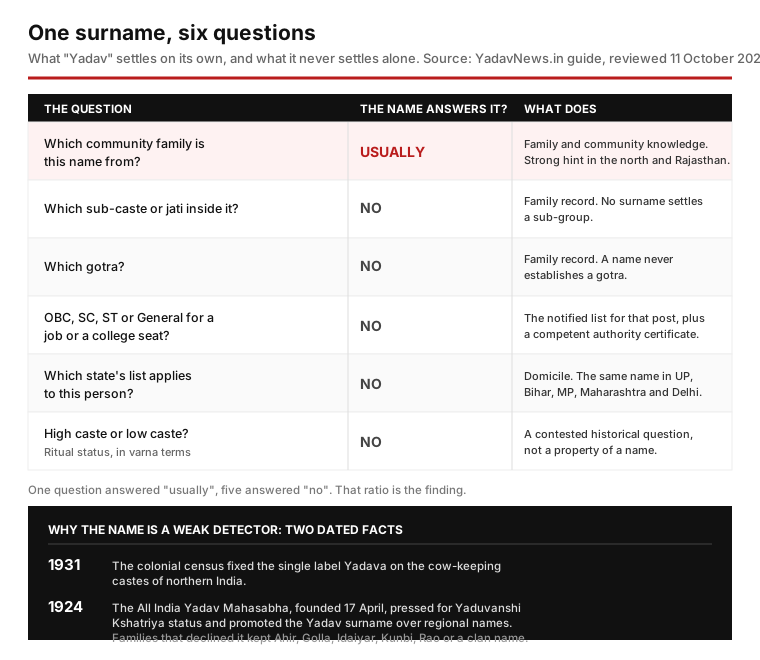
| The question you are asking | Does the surname answer it | What actually decides it |
|---|---|---|
| Which community family does this name belong to? | Usually, in the Hindi belt and Rajasthan | Family and community knowledge; the name is a strong hint, not a record |
| Which sub-caste or jati inside that family? | No | Family record. No surname resolves sub-groups |
| Which gotra? | No | Family record. A surname never establishes a gotra |
| OBC, SC, ST or General for a job or college seat? | No | The notified list governing that post, plus a certificate from the competent authority |
| Which state's list applies? | No | Domicile. Yadav is written the same way in Uttar Pradesh, Bihar, Madhya Pradesh, Maharashtra and Delhi |
| High caste or low caste? | No | Ritual varna is a contested historical question, not a property of a name |
Other names that carry the same community
These are the names the same wider family uses where Yadav is not used. Each is drawn from the encyclopaedic record or from an official Indian document, and the last two groups come from lists that decide money and seats, so their wording is worth reading exactly.
- Regional community names: Ahir, Golla, Idaiyar, Ayar, Kunbi, Rao, Abir.
- Names inside Bihar's schedule of the Central List of Other Backward Classes: entry No. 104 reads Yadav with Gwala, Ahir, Gope and Sadgope in a single entry.
- Names counted together in the 2022 Bihar Caste-Based Survey: Yadav with Ahir, Gowala, Gora, Ghasi, Mehar and Sadgop, returned as one bloc at 1,86,50,119 people and 14.26% of the state.
- Clan and sub-group names that recur in north Indian Ahir and Yadav compilations, especially Haryana, Rajasthan and western Uttar Pradesh: Dagar, Dahiya, Rathi, Banaphar, Apharia, Solanki, Tomar, Nikumbh, Bagria or Babria, Phatak and Pancholi. Those are clan labels as much as brahmanical gotras, and community registers for them are kept region by region, by no central authority, so no list of them is exhaustive.
The two official bundles are not the same list of names, and that is worth noticing before anyone matches a percentage from one against an entry in the other. The state-page detail is on Yadav caste category in Bihar.
Surnames people mix up with Yadav
Yaduvanshi and Yadu are lineage labels, not separate backward-class entries: the Mahasabha's campaign asked for people to be recorded as Yaduvanshi Kshatriyas, and the word travels into names and community titles. Whether a given family using Yaduvanshi falls inside a particular state's Yadav entry is a question about that state's notified wording, and we have not verified it state by state. The caution runs in both directions. A backward-class entry is read against the names written in it, so a name that merely sounds adjacent to Yadav does not import the entry with it. Whether some families carry a sound-alike name that a list treats separately is a state-list question, and YadavNews publishes no guess about which ones.
"Which caste is [famous person] Yadav?"
Searches of that shape spike whenever a squad is announced or a result comes in, because in a scorecard or a ticket list the surname is the only community signal visible. Two answers exist and they are different.
The public one: the surname places the person inside the consolidated Yadav and Ahir community family described above, which is why cricket and election coverage generates these searches at all. Our profiles of Suryakumar Yadav, Kuldeep Yadav, Umesh Yadav, Lalu Prasad Yadav and Akhilesh Yadav verify public record, and the full index is the Yadav personalities guide. For why the surname keeps trending, see our note on Yadav names in the news.
The private one: an individual's gotra, sub-group and family lineage are not public information, and YadavNews does not infer them from a surname. Every biography we publish follows that rule, which is why our profile pages carry no gotra field.
Where the surname carries no weight at all
For any reservation claim, the operative document is a certificate issued by a competent authority and read against the list that governs the specific post. The Central List of Other Backward Classes covers union-government jobs and centrally administered institutions. Each state maintains its own list and its own rules for state posts, and Bihar issues its backward-class certificates in BC and EBC labels with a non-creamy-layer form. A surname, a community website table, and a family's self-description all carry zero administrative weight. The mechanics, including the creamy-layer test that filters families and not castes, are on Yadav OBC or General.
The one place the surname has to be checked
Traditional Yadav and Ahir marriage practice follows the north Indian norm of gotra exogamy: a couple should not share a gotra, and in many families not a clan or vansh either, even where both partners are Yadav. Sharing the surname is not the bar; gotra is. That is why two people both surnamed Yadav can marry within community custom if their gotras differ, and why families ask the gotra question and not the surname question. The evidence behind gotra lists, and the reason no count of them is authoritative, is on the gotra and varna guide.
What we verified here, and what we did not
Verified against the sources listed below: the 1931 consolidation under the Yadava label, the Shudra classification in the colonial census, the Mahasabha's founding date and its surname campaign, the regional community names, the wording of entry 104 in Bihar's central-list schedule, the survey bundle and its figures, and the certificate framework. Not verified by us, and marked as such above: whether families surnamed Yaduvanshi fall inside a given state's Yadav entry, any exhaustive list of Ahir or Yadav clan names, and which of Bihar's BC or EBC tiers the Yadav row occupies in the state's own list. Where a claim about a surname would require knowing a living person's family record, we decline to make it.