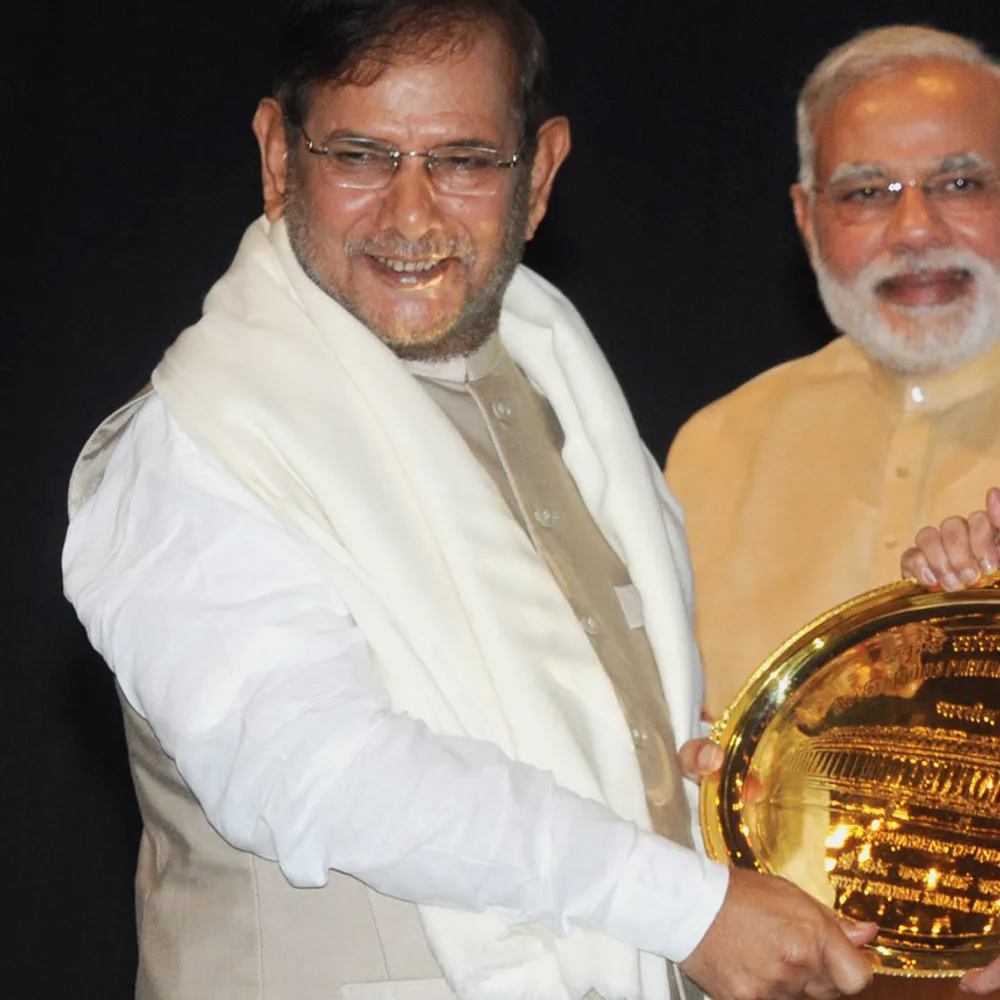
Biography & Career Overview
Sharad Yadav (1 July 1947 – 12 January 2023) spent five decades inside Indian parliamentary politics and did it from three different states. The English Wikipedia article on him records seven Lok Sabha terms and four Rajya Sabha terms, four Union cabinet portfolios, the presidency of Janata Dal (United) from its founding in 2003 until 2016, and disqualification from the upper house in 2017 that ended a parliamentary run begun in 1974. He won his first seat at 27, in a by-poll, while in judicial custody. At Madhepura he was elected four times and defeated four times as often, and fought the seat each time.
His constituency record is the unusual part. He sat for Jabalpur in Madhya Pradesh twice, for Budaun in Uttar Pradesh once, and for Madhepura in Bihar four times, a spread the Wikipedia article itself calls rare. His party record is harder to summarise: Bharatiya Lok Dal, Janata Party, Lok Dal, Janata Dal, Janata Dal (United), Loktantrik Janata Dal, and finally the Rashtriya Janata Dal ticket on which he fought his last election in 2019. The through-line is the socialist politics of Jayaprakash Narayan and Ram Manohar Lohia, which he picked up as a student in Jabalpur in 1970 and never traded for a different ideology, only for different parties carrying the same one.
This archive carries him because the Yadav surname in Indian public life runs through his career twice. The article records that he pressed the V. P. Singh government to implement the Mandal Commission report on reservations for backward classes, and that his 1999 Madhepura contest against Lalu Prasad Yadav was watched for what its result would say about the electoral preferences of the Yadav community.
Babai, and the engineering college at Jabalpur
Yadav was born on 1 July 1947 to Nand Kishore Yadav and Sumitra Yadav in Babai, a village in Hoshangabad district in what is now Madhya Pradesh. He took a Bachelor of Science at Robertson College in Jabalpur, the institution that later became the Government Science College, and then a Bachelor of Engineering in electrical engineering at Jabalpur Engineering College, where he graduated as a gold medallist.
The college years produced the politics. He became president of the Jabalpur University Student Association in 1970 and took part in the Bihar student movement, which the article says shaped him alongside the socialist ideas of Jayaprakash Narayan and Ram Manohar Lohia. Yadav was jailed by the Jabalpur police in 1972 and again in 1975 for that work.
1974: a by-poll fought from jail
The Jabalpur Lok Sabha seat fell vacant in 1974 on the death of its sitting member, Seth Govind Das. Yadav contested the resulting by-poll for the Bharatiya Lok Dal, at the peak of the JP movement. He was 27, he was in jail, and he won.
He kept the seat in the 1977 general election, this time under the newly formed Janata Party. That formation broke in 1979 and Yadav went with Charan Singh's faction. In 1978 he had become president of the Yuva Lok Dal.
Amethi, Budaun, and four years in the upper house
The early 1980s were the worst years on his record. When Rajiv Gandhi entered the Lok Sabha through a by-poll from Amethi in 1981, Yadav was the Lok Dal candidate who lost to him. In the 1984 general election Yadav contested from Budaun in Uttar Pradesh and lost to Saleem Iqbal Shervani of the Congress.
He went to the Rajya Sabha in 1986 instead, holding the seat from 5 July 1986 to 28 November 1989. In the same years he became general secretary of the Janata Dal and chairman of its parliamentary board, offices the article dates from 1989 to 1997.
He returned to the Lok Sabha from Budaun in the 1989 election as a Janata Dal candidate, with the Congress's Ram Naresh Yadav behind him. That election was dominated by the Bofors scandal. The Congress came in as the single largest party but did not form the government, and Yadav was one of the major players in the left-wing opposition coalition that backed V. P. Singh for prime minister, with outside support from the Bharatiya Janata Party. He got his first cabinet job: Minister of Textiles and Food Processing Industries.
Mandal, 1990
The decision that fixes his place in Indian social history was taken by a cabinet, and his part in it was the pushing. The Mandal Commission report recommended reservations for Other Backward Classes. Yadav, whom the article describes as one of the most powerful members of that cabinet, pressed V. P. Singh to implement it. The government did so in 1990.
The article records that implementation led to widespread protests and brought caste politics to the forefront. Whether one reads Yadav as the architect of the decision or as one of several pressure sources inside that government, the minister who carried the demand into the cabinet was the member for Budaun, and the government that acted on it lasted eleven months.
Madhepura, and the three contests with Lalu Prasad Yadav
Yadav shifted his base to Madhepura in Bihar for the 1991 election and won it, with the Jharkhand Party's Anand Mohan finishing second. He retained the seat in 1996, defeating the Samata Party's Anand Mandal, and took the chairmanship of the Finance Committee in that parliament. Between 1997 and 1999 he was president of the Janata Dal itself.
In 1998, after the downfall of the I. K. Gujral government, he lost Madhepura to Lalu Prasad Yadav, who had split from the Janata Dal to form the Rashtriya Janata Dal. They met again in 1999 and this time Yadav won. The article records that Lalu's popularity had declined with his implication in the fodder scam, and that the contest was eagerly watched for what its outcome would say of the electoral preferences of the Yadav community.
They met a third time in 2004. Lalu contested two seats, Madhepura and Chhapra, and won both, then gave up Madhepura; the by-poll to fill that vacancy was won by the RJD's Pappu Yadav. Yadav was a Union minister in the Vajpayee government at that point, and his own seat had gone.
He came back to the Lok Sabha from Madhepura in 2009 with a margin of about 175,000 votes over the RJD's Ravindra Charan Yadav, and chaired the Committee on Urban Development from August 2009 into 2010. He lost the seat a fourth time in 2014, to Pappu Yadav, and a fifth in 2019, to the Janata Dal (United)'s Dinesh Yadav, fighting that one on an RJD ticket. Four wins and four defeats in the same constituency over twenty-eight years is the cleanest single number in his record.
Building Janata Dal (United)
The Janata Dal fractured after 1999 over whom to support at the centre. The faction led by J. H. Patel took the party into the National Democratic Alliance; H. D. Deve Gowda wanted equidistance from the BJP and the Congress and formed the Janata Dal (Secular) with his own following. The remainder, associated with Yadav, merged with Lok Shakti and the Samata Party and was registered as the Janata Dal (United) in 2003, with Yadav as its first national president. He held that post until 2016, thirteen years, longer than any other office in his career.
The party's home ground was Bihar, and the article describes it as led there by Nitish Kumar while Yadav held the national presidency in New Delhi. That arrangement ended in 2018, when Yadav disassociated himself from the party over its alliance with the Bharatiya Janata Party in the state.
Four ministries, and one sentence about walking
Yadav held four Union portfolios in the governments of V. P. Singh and Atal Bihari Vajpayee. Textiles and Food Processing Industries came first, from December 1989 to November 1990. Civil Aviation followed, from 13 October 1999 through a reshuffle in September 2001. Labour and Employment ran from September 2001 to June 2002, and Consumer Affairs, Food and Public Distribution from 1 July 2002 to 15 May 2004, when the government lost office.
His time at civil aviation drew criticism for an absence of measurable improvement in the sector, and it produced the line he is still quoted for. His own defence, recorded in the Wikipedia article, was that the subject itself was a luxury in a country of walkers: "In this country where crores of people have no other mode of transport but walking, concern for aviation is very elitist."
Rajya Sabha, the 2G panel, and the 2017 expulsion
He returned to the Rajya Sabha on 8 July 2004 and served until 16 May 2009, with a term on the Committee on Ethics from June 2006. After the 2009 election he went back to the Lok Sabha, and from March 2011 to October 2013 he sat on the joint parliamentary committee examining the allocation and pricing of telecom licences and spectrum, the inquiry behind what was called the 2G case. His name on that committee is what the article records; the findings themselves are not described there.
Yadav was elected to the Rajya Sabha again in June 2014 and again in July 2016, and chaired the Committee on Industry from July 2016 to September 2017. In 2017 he was disqualified from the house and stripped of his party posts on grounds of anti-party activity, after the party leadership moved against him. The same year he gave a speech comparing votes to a daughter's honour and suggesting that the first was the thing to defend. His fourth Rajya Sabha term ended on 4 December 2017.
He was also one of the accused in the Indian hawala case, the investigation into illegal money transfers that named several politicians across parties. The Supreme Court of India dismissed the charges against him.
Loktantrik Janata Dal, and the last election
Yadav left the Janata Dal (United) in 2018 over its alliance with the BJP in Bihar and founded the Loktantrik Janata Dal in May that year. A proposed merger with the Bahujan Mukti Party, a smaller formation registered in December 2012, was put forward and then called off. In the 2019 general election he contested Madhepura once more, this time on a Rashtriya Janata Dal ticket, and lost to the Janata Dal (United) candidate Dinesh Yadav.
Family
He married Rekha on 15 February 1989. They had a son and a daughter. His son, Shantanu Bundela, is recorded in the Wikipedia article as a postgraduate of the University of London, and the article records no elected office for him. His daughter, Subhashini Raja Rao, joined the Indian National Congress shortly before the 2020 Bihar legislative assembly election and announced that she would contest from Bihariganj; she fought that seat as a Rashtriya Janata Dal candidate and lost. The party switch in the interval is what the record shows, and nothing beyond it is published here.
Death
Sharad Yadav died on 12 January 2023 in Gurgaon, aged 75. Prime Minister Narendra Modi expressed condolences and referred to work he had done for the welfare of common people. Bihar chief minister Nitish Kumar expressed condolences and announced one day of state mourning. He was cremated with full state honours on 14 January at Ankhmau, his ancestral village in Hoshangabad district, the district of his birth.
Which Sharad Yadav this page is about
The name is common in north Indian politics, and searches for it return several office-holders and non-office-holders. It is about the Janata Dal and Janata Dal (United) parliamentarian from Hoshangabad and Madhepura who died in 2023, and it is not about Sharad Pawar of Maharashtra. The overlap between the two is the first name, and nothing in this record carries across.
How this profile was verified
Dates, offices, constituency results, margins, ministerial tenures, committee membership, the quoted sentence on aviation, the family entries and the account of his death were taken from the English Wikipedia article on Sharad Yadav, and cross-checked against the positions table in the same article and the Wikimedia Commons file page for the photograph used here. Where two dates in that article differ for the end of the civil aviation portfolio, the ministry's own reshuffle date is given and the difference is not smoothed over. The claim that he was disqualified from the Rajya Sabha in 2017 for anti-party activity, and the claim that the Supreme Court dismissed the hawala charges against him, are carried as the article states them, with the court outcome named. The slogan for which he is often remembered in Bihar election rhetoric does not appear in the consulted sources and is therefore not printed here. Corrections can be filed under the correction policy on this site.