
Direct answers up front. There is no single Yadav gotra. Yadav and Ahir families use many gotras, varying by region and sub-community, and no official register publishes a definitive count of either gotras or sub-castes. On varna, the record and the self-image genuinely disagree: Yadavs claim Kshatriya (warrior) status through Yadu and Krishna, while the colonial census operations recorded many Ahir and Yadav groups as Shudra. All three are backward-class citizens in the modern legal system, which is a different axis from varna altogether.
This page is the identity-and-lineage spoke of our Yadav caste cluster. The reservation category question is answered on Yadav OBC or General and the community overview, the kuldevta and Yadav Divas material on the hub, the Yadav caste guide.
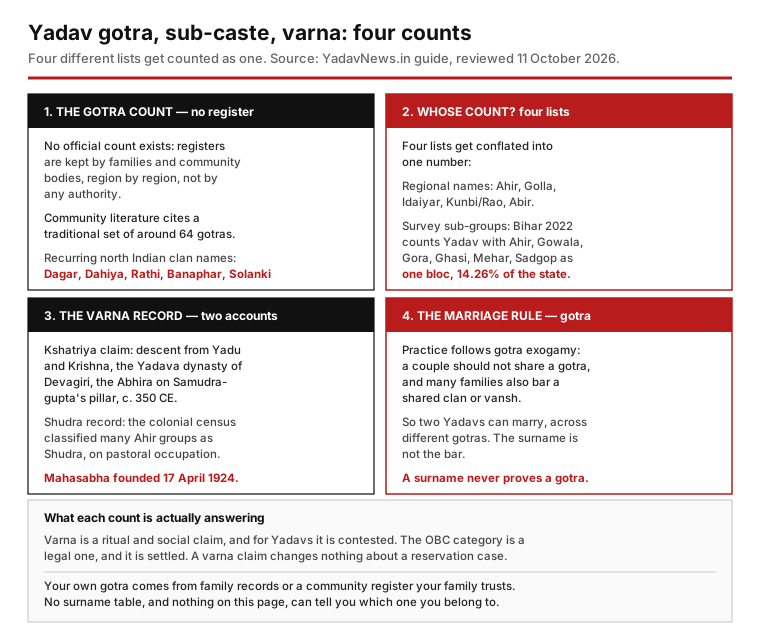
How many gotras do Yadavs have?
Nobody can give a verified number, and that is the honest answer. Three reasons:
- Gotra lists are locally maintained. Registers of Ahir and Yadav gotras and clans are kept by community bodies and families region by region, not by any state or national authority. Lists therefore disagree with one another and none is authoritative.
- Community literature cites traditional totals, most commonly a set of around 64 gotras. That is a traditional enumeration, not a verified registry, so treat "the 64 Yadav gotras" as community framing.
- The categories overlap. Many names that circulate as gotras are clan or sub-group labels, and several are shared with neighbouring communities. Any count depends on what the counter is willing to call a gotra.
Which gotra does a Yadav belong to?
It depends on the family and the region, and no website can tell you your own. What is broadly consistent across compilations:
- Many Yadav families trace a symbolic lineage to Yadu and the Chandravanshi (lunar) line. Some adopt the classical Saptarishi gotras (Kashyap, Atri, Vashisht, Vishvamitra, among others) that accompany "twice-born" status claims.
- Recurring north Indian names, especially in Haryana, in Rajasthan and in western Uttar Pradesh, include Dagar, Dahiya, Rathi, Banaphar, Apharia, Solanki, Tomar, Nikumbh, Bagria or Babria, plus Phatak and Pancholi. Those are clan and sub-group identities as much as brahmanical gotras.
- Southern branches of the same wider family use different lineage markers entirely, since they identify as Golla, Idaiyar or Ayar, not as Yadav or Ahir (see the state-wise guide).
For "yadav ka gotra kya hai" the accurate reply is that Yadavs use many gotras, that your kuldevta and marriage rules attach to your specific one, and that the only reliable source for an individual gotra is family records or a trusted community register. A surname alone never establishes a gotra, which is why we do not infer the gotra of any public figure we profile.
How many sub-castes are there in the Yadav community?
There is no fixed, officially enumerated number. The reason is that four different lists get conflated whenever someone asks for one:
| Way of counting | What it yields | Status of the number |
|---|---|---|
| Regional community names for the same wider family | Ahir, Golla, Idaiyar/Ayar, Kunbi/Rao, Abir | Documented in the encyclopaedic record. |
| Official survey sub-groups | Bihar's 2022 survey counts Yadav with Ahir, Gowala, Gora, Ghasi, Mehar and Sadgop as one 14.26% bloc | The only official enumeration we can cite; it names constituents but treats them as one category. |
| Clan and gotra names | Dagar, Dahiya, Rathi, Banaphar, Solanki, Tomar, Nikumbh and others | Community compilations; no authoritative register. |
| Traditional totals | The popular "64 gotra" framing | Community literature; not confirmed by any official list. |
So the defensible answer is that Yadav identity is a cluster of castes and clans whose membership depends on who is doing the counting: a census or survey, a state backward-class list, or a community body. Anyone publishing a single exhaustive number has chosen one of those four and is presenting it as the whole picture.
Are Yadavs Kshatriya or Shudra?
This is the oldest of the Yadav identity questions and the one that generated the modern community itself.
The Kshatriya claim. Yadavs trace descent from Yadu and from Krishna of the Vrishni clan, and point to a documented martial and ruling history: the Deccan Yadava dynasty of Devagiri; the Abhira named in Samudragupta's Allahabad Pillar inscription of about 350 CE, listed there among the tribal states whose heads acknowledged him with tribute and obedience; Ahir landholders and soldiers through the Sultanate and Mughal centuries; and recognised recruitment under the colonial "martial race" designation. Neither old label is a varna verdict. The inscription counts the Abhira with the tribal republics, alongside the Yaudheyas, and says nothing about ritual rank; "martial race" was a British administrative sorting of communities. Full detail, with the inscriptional evidence, is in the origins of the Yadav community.
The Shudra record. The colonial census operations classified many Ahir and Yadav groups as Shudra, based in part on their pastoral and nomadic occupation, and it was in the 1931 round that the cow-keeping castes of northern India successfully combined under the single label Yadava. Wikipedia's Yadav article records the tension exactly: the community is accorded Shudra status in the classical varna scheme "although the community's members often claim the higher status of Kshatriya."
What happened next. That classification triggered the early-twentieth-century Sanskritisation movement. Community bodies, above all the All India Yadav Mahasabha founded on 17 April 1924, campaigned to be recorded as Yaduvanshi Kshatriyas, promoted the Yadav surname over regional names, and assembled the genealogical and temple evidence behind the higher claim. The consolidated Yadav identity that most people search for today is partly the outcome of that campaign.
Bottom line: ritual varna is genuinely contested, the modern legal category is OBC, and in self-identity the Kshatriya Yaduvanshi claim is the dominant one. These are three different questions, and treating any one of them as the answer to all three is what makes the online debate circular.
Does gotra still matter for marriage?
Yes, and it is the practical reason gotra is still asked about. Traditional Yadav and Ahir marriage practice follows the North Indian norm of gotra exogamy: a couple should not share a gotra, and in many families must not share a clan or vansh either, even where both partners are Yadav. So "can two Yadavs marry" is not settled by the surname. Same-surname marriage is not barred by the surname itself; gotra and lineage are the operative rule, and many marriages between two Yadavs take place across different gotras. Customs differ between the Ahir, the Golla and the Idaiyar groups, and legal capacity to marry under the Hindu Marriage Act turns on degrees of lineage, not on a shared surname.
Why the gotra and sub-caste counts are not numbers
Community literature cites figures such as 64 gotras, and no state or community authority publishes a register to check them against, so this page presents those counts as contested community framings, not as numbers. It is re-reviewed if any authoritative list is published.